Some things are just too good to keep to yourself....this is one of them.
The email below is from USAF Colonel Brett Wyrick who is the commander of the 154th Medical Group, Hawaii Air National Guard, and is serving as a surgeon in Balad with the 332nd Expeditionary Medical Group. Col. Wyrick had been sending his father, a Vietnam-era fighter pilot, emails about his experiences in Iraq:
Dear Dad, If I ever hear airmen griping and complaining, I jump into them pretty quickly, now. Most people over here have nothing to gripe about compared to Marines. Marines are different. They have a different outlook on life. One Marine Private was here for several days because he was a lower priority evacuation patient. He insisted on coming to attention and displaying proper military courtesy every morning when I came through on rounds. He was in a great deal of pain, and it was a stressful to watch him work his way off the bed and onto his crutches. I told him he was excused and did not have to come to attention while he was a patient,and he informed me that he was a good Marine and would address "Air Force Colonels standing on my feet, Sir." I had to turn away so he would not see the tear in my eye. He did not have "feet" because we amputated his right leg below the knee on the first night he came in. I asked a Marine Lance Corporal if there was anything I could get him as I was making rounds one morning. He was an above the knee amputation after an IED blast, and he surprised me when he asked for a trigonometry book. "You enjoy math do you?" He replied, "Not particularly, Sir. I was never good at it, but I need to get good at it, now." "Are you planning on going back to school?" I asked. "No sir, I am planning on shooting artillery. I will slow an infantry platoon down with just one good leg, but I am going to get good at math and learn how to shoot artillery". I hope he does. I had the sad duty of standing over a young Marine Sgt. when he recovered from anesthesia - despite our best efforts there was just no way to save his left arm, and it had to come off just below the elbow. "Can I have my arm back, sir?" he asked. "No, we had to cut it off, we cannot re-attach it", I said. "But can I have my arm?", he asked again. "You see, we had to cut it off." He interrupted, "I know you had to cut it off, but I want it back. It must be in a bag or something, Sir." "Why do you want it?" I asked. "I am going to have it stuffed and use it as a club when I get back to my unit." I must have looked shocked because he tried to comfort me,"Don't you worry now, Colonel. You did a fine job, and I hardly hurt at all; besides I scratch and shoot with my other hand anyway." God Bless the Marines!
Col. Brett Wyrick
New photos over at Eidolons!
Thursday, June 29, 2006


Monday, June 26, 2006
....and the Art Goes On

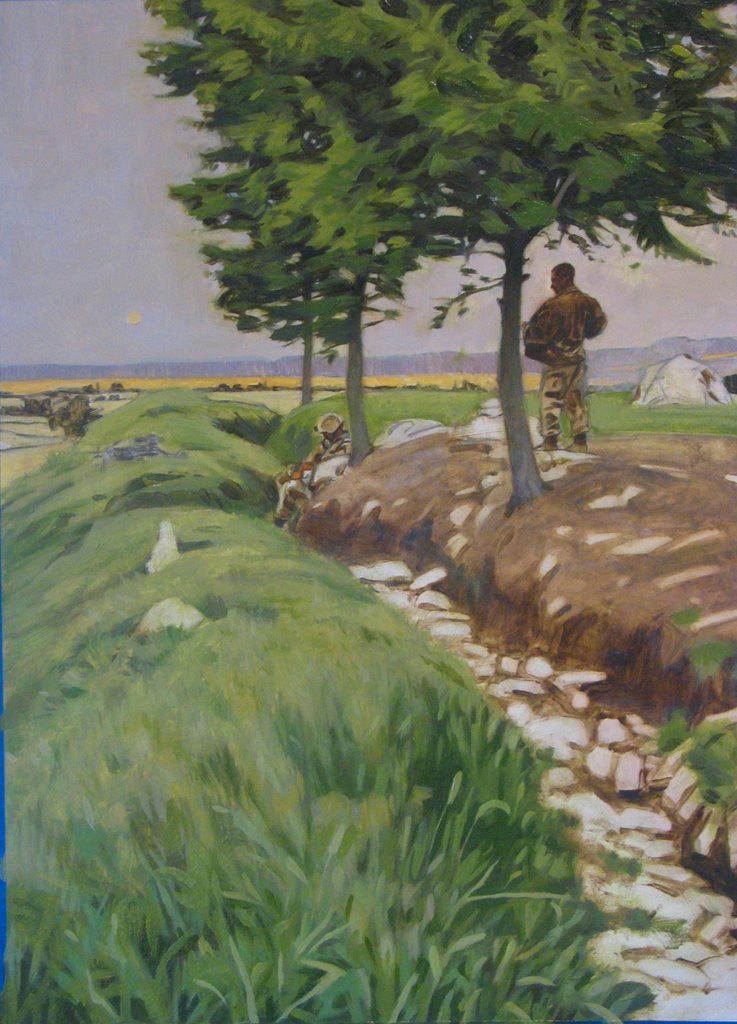 Before the Storm (work in progress)
This is the painting I'm currently working on. Like the oil study for Storm and Stone this is oils on gessoed watercolor paper. Someone asked me recently why not paint on canvas? That's a fair question. First, preparing a sheet of watercolor paper for painting is quick and easy. Second, I like the way the brush feels and responds to the rigidity of this surface....you tend to get nice expressive brush work as the bristles interact with the hardness. With canvas the surface bows away from the pressure of the brush, which means the hairs tend to stay together and produce a more uniform stroke of pigment. With the gessoed watercolor paper affixed to the 3/4 inch plywood there's little or no give from the surface, so the hairs of the brush tend to splay out more readily producing surprising little nuances. Canvas also stretches under repeated assaults, and I've been known to over aggresively scrape out passages I'm not satisfied with resulting in a spongy and over-relaxed surface. You have the sensation of trying to run a marathon on a trampoline...not pleasant.
I've decided to put off starting the finished version of Storm and Stone until late July. I'm scheduled to attend the Basic Reserve Warrant Officer Course July 17th. The class only lasts two weeks, but they cram the entire 3 months of the Regular Warrant Officer Course into it. How can they do that? Easy, they give you a ton of professional reading to do prior to showing up. So between the reading and going to the gym to get my ancient keester in shape I realized that this was not the time to take on a major work. Instead I'm going to focus on a series of modest finished oil sketches.
In doing these sketches I'm also challenging myself to transition from "drawing" with oils to actually "painting" with them. What the heck does that mean? It means rather than laying down a highly developed drawing and then basically coloring it in, you only put down a cursory sketch and then going at it with large brushes laden with generous amounts of pigment. This forces you to conceive in terms of color and mass, rather than with line and value. Two adjustments I make, due to the normal extended drying time of oils, is to use a mixture of 50/50 light drying oil and copal medium, and alklyd white. This results in a much faster drying time, which means passages can be reworked sooner rather than later.
I don't think I'll ever be a true alla prima painter, but I want to move in that direction. A year ago I was privileged enough to meet and attend a lecture by America's alla prima master, Richard Schmid. The things this artist can do with big brushes is beyond amazing. Mr. Schmid shared an interesting personal anecdote with me, back in the early 1950s he took over the apartment that former WWII Marine combat artist Harry Jackson was sharing with Jackson Pollack.
The unfinished scene I'm sharing with you today is of a patrol base overlooking the village of Khogyani in the foothills of the Tora Bora Mountains near the Wazir Pass. We had just finished a long day of bouncing through the countryside doing a reconnaissance in force. Our main objective was to identify alternative avenues of approach for a future operation slated for the foothills of the Tora Boras on the Pakistani border.
The site selected to set up for the evening was a small terraced hillcock encircled by a chest high irrigation ditch; a perfect defensive position. Perched along this dry ditch lined with river rocks were clusters of mulberry trees. Marines spit up into twos, with one man taking watch while the other dug a fighting hole and set up their tent.
This particular evening was transcendently beautiful. Small groups of shepherd boys wandered out from the village with their flocks of goats and sheep. The air was peppered with the sound of their voices, the occassional thwack of homemade slingshots proding errant animals back into the fold, and the omnipresent hew-hawing of donkeys. The air was so still and sound carrying so far that the Marines could hold conversations easily with the listening post half a kilometer away on an adjoining hill.
As is always the case in the Middle-East, the melodic lilt of an evening prayer floated up from a mosque nestled somewhere amongst Khogyani's maze of mud daub homes and meandering walled streets. By nightfall the boys had drifted off and down in the darkening village doors and windows began to light up with gemlike warmth.
It was the calm before the storm. At about three in the morning a cyclonic thunderstorm rocked our world.
Quick, Hand Me the Ducktape!
Well, the Democratic slight of hand, as predicted, continues. The Washington Post, in an article today titled Democrats Site Report on Troop Cuts in Iraq, heavily quotes Dem spokesmodel Senator Barbara Boxer (D-Calif). She says (get ducktape out now and begin wrapping your head):
"That means the only people who have fought us and fought us against the timetable, the only ones still saying there shouldn't be a timetable really are the Republicans in the United States Senate and in the Congress,"....... "Now it turns out we're (the Dems) in sync with General Casey."
So, let me see if I understand her correctly. The Dems are the true force behind success in Iraq, and they and our military are reading off the same sheet of music. Man, I hope this ducktape holds. There is a reason why there are phrases like "flies in the ointment", "zits on the ass of progress", "sunshine patriots", "useful idiots" and "lambs to the slaughter". Let me add a new one; sheep in foxes' clothing. Some folks just seem intent on falling all over each other competing to become the next poster child for these sayings. Neville Chamberlain, Charles Lindbergh and Benedict Arnold please step aside.
Correct me if I'm wrong, but the Republican stance, bolstered by the votes of significant Democrats , was and simply is that we shouldn't telegraph our exit, or any other plans for that matter. You know....the old hold your cards close to your chest thing when playing a serious game of high stakes poker. Yes, we have a plan to leave, and the insurgents don't need to know it. So, it turns out, if Boxer's spin is to be believed, the NYTs' exposure of classified information about proposed troop reductions published over the weekend was really an even a deeper revelation of classified super-duper secret plans by the Democrats to win the war...not to mention the chummy Vulcan mindmeld they have with higher ups in the military. Rumsfeld is no doubt instituting a kristallnacht purge over at DoD even as we speak.
Sarcasm aside, the disengeniousness of this blither is transparent. Dems and lefties love to tell us what things "mean". Do they think we're stupid? We're at war. You don't ever telegraph your intentions, movements and capablities to the enemy. EVER. Boxer and the Dems are not in sync with General Casey. The Republican victories last week, courageously aided by centerist Democrats, were not rebukes of an Iraqi exit timetable, but simply affirmations of American resolve in the face of a resolute foe married to a common sense recognition that these bastards don't need to know the who, what, where or when of what we're up to. The fledgling Iraqi government needs to know we're there for the long haul, the GIs must know that their efforts are to good purpose and the enemy needs to know we aren't going anywhere soon. Get in sync with that Senator Boxer.
I like to give credit where credit is due, and an article on the frontpage of today's NYTs allowed me to loosen the ducktape around my head a little this morning while sitting at my favorite coffee shop, Hyperion Espresso. Amid Iraqi Chaos, Schools Fill After Long Decline, though it has the predictable spin leavening the piece enough to appeal to the palate of its core lefty readers, manages in spite of itself to tell some good news and speak of the plan that a previous posting of mine referred to. I love this quote:
"Despite the violence that has plagued Iraq since the American occupation began three years ago, its schools have been quietly filling."
The telling rhetoric comes from the use of the word "occupation". Couldn't use the word "liberation" now could we. At anyrate, go read it. And while you're at it, go read this piece from the Washington Post about another war zone, Washington, DC, where schools are emptying at an alarming rate. The story is about two friends who bucked the odds. How did they do it? Hint, it involves the word fathers.
"That means the only people who have fought us and fought us against the timetable, the only ones still saying there shouldn't be a timetable really are the Republicans in the United States Senate and in the Congress,"....... "Now it turns out we're (the Dems) in sync with General Casey."
So, let me see if I understand her correctly. The Dems are the true force behind success in Iraq, and they and our military are reading off the same sheet of music. Man, I hope this ducktape holds. There is a reason why there are phrases like "flies in the ointment", "zits on the ass of progress", "sunshine patriots", "useful idiots" and "lambs to the slaughter". Let me add a new one; sheep in foxes' clothing. Some folks just seem intent on falling all over each other competing to become the next poster child for these sayings. Neville Chamberlain, Charles Lindbergh and Benedict Arnold please step aside.
Correct me if I'm wrong, but the Republican stance, bolstered by the votes of significant Democrats , was and simply is that we shouldn't telegraph our exit, or any other plans for that matter. You know....the old hold your cards close to your chest thing when playing a serious game of high stakes poker. Yes, we have a plan to leave, and the insurgents don't need to know it. So, it turns out, if Boxer's spin is to be believed, the NYTs' exposure of classified information about proposed troop reductions published over the weekend was really an even a deeper revelation of classified super-duper secret plans by the Democrats to win the war...not to mention the chummy Vulcan mindmeld they have with higher ups in the military. Rumsfeld is no doubt instituting a kristallnacht purge over at DoD even as we speak.
Sarcasm aside, the disengeniousness of this blither is transparent. Dems and lefties love to tell us what things "mean". Do they think we're stupid? We're at war. You don't ever telegraph your intentions, movements and capablities to the enemy. EVER. Boxer and the Dems are not in sync with General Casey. The Republican victories last week, courageously aided by centerist Democrats, were not rebukes of an Iraqi exit timetable, but simply affirmations of American resolve in the face of a resolute foe married to a common sense recognition that these bastards don't need to know the who, what, where or when of what we're up to. The fledgling Iraqi government needs to know we're there for the long haul, the GIs must know that their efforts are to good purpose and the enemy needs to know we aren't going anywhere soon. Get in sync with that Senator Boxer.
I like to give credit where credit is due, and an article on the frontpage of today's NYTs allowed me to loosen the ducktape around my head a little this morning while sitting at my favorite coffee shop, Hyperion Espresso. Amid Iraqi Chaos, Schools Fill After Long Decline, though it has the predictable spin leavening the piece enough to appeal to the palate of its core lefty readers, manages in spite of itself to tell some good news and speak of the plan that a previous posting of mine referred to. I love this quote:
"Despite the violence that has plagued Iraq since the American occupation began three years ago, its schools have been quietly filling."
The telling rhetoric comes from the use of the word "occupation". Couldn't use the word "liberation" now could we. At anyrate, go read it. And while you're at it, go read this piece from the Washington Post about another war zone, Washington, DC, where schools are emptying at an alarming rate. The story is about two friends who bucked the odds. How did they do it? Hint, it involves the word fathers.
Tidbits
As a result of a comment left by a fellow blogger and a couple e-mails between she and I there's now a new blogsite I want to call your attention to...Neo-neolib. Give it some support.
Also, Pat Dollard is featured in todays New York Post scewering former sexiest man of the year George (C)looney. I wonder how much carbon based material he manages to spew into the atmosphere everytime he jets to and from his villa in Italy? Check out this ABC News piece about Vanity Fair's first ever "green issue" which sports, among others, (C)looney on the cover. Hypocrisy anyone? Do as I say and not as I do...the zen thing again. I've told my daughter in no uncertain terms that (C)looney will not portray me in any future Hollywood movie about my adventures! Mel Gibson for sure, but (C)looney never!
Also, Pat Dollard is featured in todays New York Post scewering former sexiest man of the year George (C)looney. I wonder how much carbon based material he manages to spew into the atmosphere everytime he jets to and from his villa in Italy? Check out this ABC News piece about Vanity Fair's first ever "green issue" which sports, among others, (C)looney on the cover. Hypocrisy anyone? Do as I say and not as I do...the zen thing again. I've told my daughter in no uncertain terms that (C)looney will not portray me in any future Hollywood movie about my adventures! Mel Gibson for sure, but (C)looney never!
Sunday, June 25, 2006
The Plan
One of the slight of hand rhetorical devices trotted out ad nauseum by pundits on the left which strikes me as particularly odd is the "there is no plan" talking point. Of late it either leads, or follows on the heals of some disengenious pity party about the heroic and well intentioned troops who, though entitled to great leadership, are subject to the evil and bumbling ruling triumvirate of Bush, Cheney and Rumsfeld.
The new catch phrase, in the wake of failed congressional "cut and run" votes, is "the troops deserve better". Now, of course, the NY Times and the LA Times are not held to the same moral obligation to the troops, unless one believes that revealing classified operations during wartime is looking out for our welfare. For instance, America's newspaper of discord today again tried to protect us by publishing classified troop reduction plans. Were I to write about what is essentially troop movement information, I'd be looking at serious time at Leavenworth.
I have a Top Secret Clearance, and although one may legitimately wonder why an artist would need one, let me assure you that it comes in handy. Having a TS (SCI Eligible) has allowed me to stand in on the highest command briefings. As a result I'm able to position myself in my capacity as a combat artist, when either in Afghanistan or Iraq, where the action is most likely to happen.
My little studio back at Camp Fallujah was in a high security touch-pad entry building housing the working spaces of the 6th Provisional Civil Affairs Group. These guys were networking with everyone from the State Department, Navy Seabees, US Department of Agriculture advisors to all the NGOs (non-governmental organizations). They held at least one major briefing a week and the paper thin walls permitted hearing any number of in-depth discussions and planning sessions. I also attended one major status briefing given to the commanding general which covered every possible human need and endeavor necessary for nation building. Let me assure you, there is a plan.
With three election cycles successfully completed, the relative pacification of the city of Fallujah accomplished, 16 out of 18 provinces stabilized, a government created from scratch, Zarqawi eliminated, a civil war averted and an Iraqi army trained and fielded events bear witness to this ongoing plan. I find it odd that the press folks, always given their own thorough semi-classified overviews by military public affairs officers, have conveniently failed to acknowledge all the planning behind the multitude of coordinated missions being carried out. The professionalism of the armed forces is often alluded to, but with a careful side-stepping of the nuts and bolts. This is another way that the "support the troops, but not the war" is cultivated with PC deftness.
So I'm left feeling odd...little ole me knows there's a plan, 140,000 other GIs know there's a plan, civilians in various governmental and non-governmental organizations know there's a plan, and significant Iraqi politicians like the mayor of Tal' Afar praises the plan, and yet the liberal MSM is blissfully unaware. How so? They're obviously privy to other stuff, and more than willing to highlight even the most sensitive of material.
What's usually held up as the main evidence against there being a US plan, at least in the MSM? The ongoing violence. Do you think perhaps the enemy, seeing that the plan is working, is getting even more desperate? Apparently significant intelligence gathered on or near Zarqawi's rapidly cooling body bore testament to this fact. The terrorists don't perputrate more heinous acts because they think they're winning. On the contrary, they do it because they know they are loosing. Zarqawi lived long enough to know that it was the US that got him, and died admitting to himself that he had failed to ignite a Sunni-Shia civil war and that his swath of beheadings and suicide bombings had managed to turn-off significant support in Iraq for jihad.
Paradoxically, terrorism itself is the the greatest spokesman for the existence of an effective plan. The more things progress towards democracy in Iraq, the greater the lengths gone to either derail or defame the hard won advances. The derailing being done by insurgents and the defaming by.....well you know.
Today there was a very interesting posting over at the Daily Kos illustrating the bizarre twisted logic of the left. A Kos clone named DarkSyde has a piece titled Iraqi Government Embraces Democratic Proposals. Looks like the left is starting to realize that democracy might just take hold in Iraq and is ginning up the spin-a-trons to frame such success as somehow further proof of a failed strategy; it'll be very soon, now that the baby is taking its first steps, that moonbats will be rushing in to take credit. Believe me, the biggest nightmare for folks on the left isn't global warming, loss of personal freedoms, Christian jihad or a gay-marriage ban, no, it's American resolve and ingenuity carrying the day in Iraq and their failure to regain the White House. Apparently the Iraqi Prime Minister's proposed plan for US withdrawal is a "stinging rejection of Republican rhetoric". Don't they get it, reject our rhetoric all you want, especially if it means you're embracing democracy and acting with independent soverign resolve. Which is exactly what Iraq is starting to do....go figure. But like I said, there is a plan.
The new catch phrase, in the wake of failed congressional "cut and run" votes, is "the troops deserve better". Now, of course, the NY Times and the LA Times are not held to the same moral obligation to the troops, unless one believes that revealing classified operations during wartime is looking out for our welfare. For instance, America's newspaper of discord today again tried to protect us by publishing classified troop reduction plans. Were I to write about what is essentially troop movement information, I'd be looking at serious time at Leavenworth.
I have a Top Secret Clearance, and although one may legitimately wonder why an artist would need one, let me assure you that it comes in handy. Having a TS (SCI Eligible) has allowed me to stand in on the highest command briefings. As a result I'm able to position myself in my capacity as a combat artist, when either in Afghanistan or Iraq, where the action is most likely to happen.
My little studio back at Camp Fallujah was in a high security touch-pad entry building housing the working spaces of the 6th Provisional Civil Affairs Group. These guys were networking with everyone from the State Department, Navy Seabees, US Department of Agriculture advisors to all the NGOs (non-governmental organizations). They held at least one major briefing a week and the paper thin walls permitted hearing any number of in-depth discussions and planning sessions. I also attended one major status briefing given to the commanding general which covered every possible human need and endeavor necessary for nation building. Let me assure you, there is a plan.
With three election cycles successfully completed, the relative pacification of the city of Fallujah accomplished, 16 out of 18 provinces stabilized, a government created from scratch, Zarqawi eliminated, a civil war averted and an Iraqi army trained and fielded events bear witness to this ongoing plan. I find it odd that the press folks, always given their own thorough semi-classified overviews by military public affairs officers, have conveniently failed to acknowledge all the planning behind the multitude of coordinated missions being carried out. The professionalism of the armed forces is often alluded to, but with a careful side-stepping of the nuts and bolts. This is another way that the "support the troops, but not the war" is cultivated with PC deftness.
So I'm left feeling odd...little ole me knows there's a plan, 140,000 other GIs know there's a plan, civilians in various governmental and non-governmental organizations know there's a plan, and significant Iraqi politicians like the mayor of Tal' Afar praises the plan, and yet the liberal MSM is blissfully unaware. How so? They're obviously privy to other stuff, and more than willing to highlight even the most sensitive of material.
What's usually held up as the main evidence against there being a US plan, at least in the MSM? The ongoing violence. Do you think perhaps the enemy, seeing that the plan is working, is getting even more desperate? Apparently significant intelligence gathered on or near Zarqawi's rapidly cooling body bore testament to this fact. The terrorists don't perputrate more heinous acts because they think they're winning. On the contrary, they do it because they know they are loosing. Zarqawi lived long enough to know that it was the US that got him, and died admitting to himself that he had failed to ignite a Sunni-Shia civil war and that his swath of beheadings and suicide bombings had managed to turn-off significant support in Iraq for jihad.
Paradoxically, terrorism itself is the the greatest spokesman for the existence of an effective plan. The more things progress towards democracy in Iraq, the greater the lengths gone to either derail or defame the hard won advances. The derailing being done by insurgents and the defaming by.....well you know.
Today there was a very interesting posting over at the Daily Kos illustrating the bizarre twisted logic of the left. A Kos clone named DarkSyde has a piece titled Iraqi Government Embraces Democratic Proposals. Looks like the left is starting to realize that democracy might just take hold in Iraq and is ginning up the spin-a-trons to frame such success as somehow further proof of a failed strategy; it'll be very soon, now that the baby is taking its first steps, that moonbats will be rushing in to take credit. Believe me, the biggest nightmare for folks on the left isn't global warming, loss of personal freedoms, Christian jihad or a gay-marriage ban, no, it's American resolve and ingenuity carrying the day in Iraq and their failure to regain the White House. Apparently the Iraqi Prime Minister's proposed plan for US withdrawal is a "stinging rejection of Republican rhetoric". Don't they get it, reject our rhetoric all you want, especially if it means you're embracing democracy and acting with independent soverign resolve. Which is exactly what Iraq is starting to do....go figure. But like I said, there is a plan.
Saturday, June 24, 2006
Yeah, Another One
Couldn't resist...have fun!
Staying on a positive note let me give you a couple links where you can support two standup guys, though very different, who are making a difference. One is Senator Joe Lieberman (D-Conn), a gentleman who's not a politician, but a statesman. That he's a Democrat matters not at all to me. Supporting him with a donation is just the right thing to do. The other is my crazed Gonzo documentarian buddy Pat Dollard. He needs financial support to finish his Hollywood outsider "Young Americans" project. Senator Lieberman has stood by the troops in the halls of Congress and Pat has stood with the troops in the field. They both epitomize standing true to oneself and those on the side of right regardless of the dangers to career or carcus.
| You Are 72% Open Minded |
 You are a very open minded person, but you're also well grounded. Tolerant and flexible, you appreciate most lifestyles and viewpoints. But you also know where you stand firm, and you can draw that line. You're open to considering every possibility - but in the end, you stand true to yourself. |
Staying on a positive note let me give you a couple links where you can support two standup guys, though very different, who are making a difference. One is Senator Joe Lieberman (D-Conn), a gentleman who's not a politician, but a statesman. That he's a Democrat matters not at all to me. Supporting him with a donation is just the right thing to do. The other is my crazed Gonzo documentarian buddy Pat Dollard. He needs financial support to finish his Hollywood outsider "Young Americans" project. Senator Lieberman has stood by the troops in the halls of Congress and Pat has stood with the troops in the field. They both epitomize standing true to oneself and those on the side of right regardless of the dangers to career or carcus.
Same As It Ever Was
 Here's a political cartoon from the 1864 election. Drawn by Thomas Nast, it was a comment on the Democratic Party's "cut and run" Copperhead platform. The inscription on the tombstone is the Civil War version of I support the troops by not the war: "In memory of our Union Heroes who fell in a Useless War." Pre-election the Dems were uber confident that homesick, disgruntled and battle weary Union soldiers would vote en masse for their former commanding general, George B. McClellan. McClellan had been relieved by President Lincoln after the Battle of Antietam. McClellan had little stomach for actual combat and had a predictable Chicken Little tendency to always see a falling sky by consistently overestimating Southern forces and capabilities. He was more about spin and a whole lot less about win. Here's a quote from the History Channel website:
An able administrator and drillmaster, McClellan proceeded to reorganize the army for what he expected to be an overwhelming demonstration of Northern military superiority. Popular with his troops, the 34-year-old commander was also a conceited, arrogant man, contemptuous of the president and already suspect among Republicans because he vigorously opposed any tampering with the institution of slavery. Ultimately, his tendency to overestimate the enemy and his excessive caution wore out Lincoln’s patience.
His lack of fighting elan, and over-confidence in the enemy's forces, rather than his own, ultimately wasted lives through his failure to effectively capitalize on the near death blow Lee's forces recieved at Antietam September 17, 1862, and thus hasten the end of fighting. Lincoln sent him back to civilian life November 17 with the now famous quote, "If you don't want to use the army, I should like to borrow it for a while."
The Dems of that day were also heartened by the Draft Riots they had openly provoked, particularly in New York City, with inflammatory newspaper screeds about a failed mission coupled with the specter of emancipated blacks flooding the northern job market; blacks freed in a war originally sold as being more about restoring the Union and less about eliminating the institution of slavery.
Lincoln was convinced that he was going to be handed a historic loss. He couldn't have been more wrong. Naysaying and doom-mongering fell flat and Lincoln had a victory of historic proportions; 212 to 21 votes in the electoral college and 55% to 45% in the popular vote. The Union Army supported Lincoln with a 78% margin. America's resolve behind Lincoln and staying the course made the Emancipation Proclimation a permanent fact, rather than a passing fancy. If the Dems had had their way passports would be needed today to go from Pennsylvania to Maryland, and the Underground Railroad would be operating still.
What prompted today's post? An article in the June 23rd issue of The Washington Post about the ongoing presidential aspirations of failed vice-presidential candidate, former senator and North Carolina ambulance chasing lawyer John Edwards. Edwards is tauting a two pronged platform of eliminating poverty in the US and restoring America's place on the heights of the world's moral high ground. He advocates an immediate removal of 40,000 troops from Iraq (the remainder out in 12-18 months), and a re-deployment of tax money, to the tune of 15 to 20 billion a year, in a return to fighting the War on Poverty. So let me see if I've got him right....getting everyone in the world to think America is swell again is the cure for international jihad. And, throwing more money at poor people will stop poverty. The moral high ground is apparently reached through good PR rather than confronting evil. Telling everyone that we're all about democracy and a just world needs to replace actually doing something concrete about it. How zen! Do by not doing grasshopper. Stop evil by not stopping evil! Stop poverty by paying the poor for being poor! Think big thoughts, use big words, espouse big ideas! Before we know it est will be back. All evil requires to fail is for good men to do nothing (apologies to Edmund Burke). I wouldn't be surprised if 500,000 Rwandans don't just rise up out of their graves after realizing they had mistakenly run into machetes during the Clinton era, surely Edwards' golden age of America's death grip on the moral high ground. And the 7 trillion wasted on the previous War on Poverty....siphoned off by Haliburton no doubt.
Somethings never change. Politicians preaching easy pie in the sky solutions, trumpeting bad news and instigating open disloyalty during a time of war. The New York Times and the LA Times yesterday, disregarding pleas from our government, revealed to friend and foe alike a formerly secret operation that has since 9/11 effectively identified and thwarted our enemy. The death of Al-Zarqawi widely minimized, the horrendous deaths' of American servicemembers relativized in a haze of moral equivalency, a preemptive disruption of a terror plot in Miami marginalized (amazing how the Left gets away with buffooning these homegrown terrorists-I just listened to the NYTs' Maureen Dowd on FoxNews disparagingly lampoon the Miami conspirators as "not being able to find the local Sears, let alone the Sears Tower"), and attempts at downplaying three sets of elections in Iraq are but a few of the trends actively and predictably spun from folks on the left. Their hypocrisy is as transparent as their well-meaning rationalizations are delusional. WE ARE AT WAR.
Hey, remember, I'm not a ranting neo-con 24/7, check out my soft underbelly....visit my new photoblog. Thanks.
Thursday, June 22, 2006
My Truth
Two fellow American servicemembers have been kidnapped, horribly tortured and murdered by Islamofascists in Iraq. The reactions in the liberal press, media and blogosphere is at best ambivalent and at worst wallowing in an orgy of moral equivalency and transparent political opportunism glommed on to this intolerable act. These same folks revelled in words such as barbaric, horrific and torture to describe and politically charge events at Abu Ghraib Prison, and practices at the military detention facility at Gitmo. Now something truly in the full spirit of these words has happened to fellow Americans and the Libs, having spent these powerful adjectives like so much spare change on lesser evils supposedly perputrated on greater villians, reveal their moral bankruptcy. Mike Luckovich, political cartoonist, Occams Hatchet a hack over at Daily Kos, and political writer Andrew Sullivan stand out as three particularly deserving of our disgust. Given the choice between Gitmo and a gaggle of Muslim fanatics I wonder who they'd choose to spend a few days in the custody of?
Even while these two soldiers were being hideously tortured and mutilated a clique of Senate and House Democrats were, and still remain fixated on forming and implementing a plan for defeat in Iraq. These hapless politicians want to (cut and) run the war and the President wants his generals on the ground to be the final arbiters of the campaign. WE ARE AT WAR. This supercedes politics. Today the US Senate defeated two Democrat sponsored amendments calling for the withdrawal of US forces by a margin of 86-13. Maybe a certain senator from Massachusetts, having voted for the amendments would now like the opportunity to vote against them.
The unspeakable deaths of these two patriots, fighting the good fight in a noble cause moves me to speak. This is my truth, the ultimate ground of being if you will, upon which my opinions here at Fire and Ice are anchored. We are at war. If you do not believe and accept this then I hold you in abject scorn. You are either stupid by default, or a traitor by design. I will not waste my time trying to convince you otherwise. Our energy is needed else where; the actual War. We are in a death roll with a brutal, barbaric and retrogressive movement called Islamofascism. Our adversary is intent upon our utter defeat. Our adversary is wise and knows that this will not happen as a result of conventional warfare. They have selected a strategy we call Terrorism. Terrorism has one goal; to break our will and to defeat us from within. The Left, the Liberals, the Democratic Party, the Moonbat community, has contributed nothing since 9/11 to the national political will absolutely central to defeating our enemies. They have allowed what little resolve they initially possessed to be wicked away by their lack of character and devotion to prurient self-interest. This amounts, from this warrior's perspective, to aiding and abetting the enemy during a time of war.
This global conflict, in the final analysis, is literally being waged in the very heart, soul, will and governing institutions of our American republic. The Left's gang of useful idiots, Daily Kos, has delusionally framed their capitulation to terrorism as merely an "honest and spirited debate", while the war footing and fighting posture of the Right is described as "lemming-like devotion to a failed strategy". The troops are not fooled one iota as to the nature of our enemy in the field, nor the primary goal of the Left here at home. The collective Left is obsessed with the loss of the Presidency in 2000 to George W. Bush. That is their ground of being. They believe that the world needs to be protected from America and they're just the people to make that happen. No matter how you dress it up, no matter if the US has found effective ways to ferret out terrorists and proactively prevent future acts of true victimization, that's their plan. They want America's head to be stuck firmly in the sand and our playing cards face up on the table. I believe America is protecting the world. They see a world where America victimizes. I, on the other hand, have devoted myself to world where America is victorious. So, as I've said before, LEAD, FOLLOW, or GET OUT OF THE WAY!
As someone who formerly identified himself strongly as a left leaning progressive my heart goes out to folks like Peter Beinhart, Senator Joseph Lieberman and the Euston Manifesto signers. One bright clear morning they'll hopefully wake up, come out of the political closet, look in the mirror and say with epiphanal relief, "Holy crap, I'm a neo-con!" I'm thankful that there are people still courageous enough to identify themselves with the labels of "liberal" and "progressive" and at the same time eloquently speak beyond narrow partisan politics to what is simply right; people like Victor Davis Hanson and Christopher Hitchens are prime examples of measured thought out commentaries; unlike Markos Moulitsas Zuniga, founder of Daily Kos, who hiding behind a legion of authorized minions, spews out numerous commentaries on current events garnished with generous and sophmorically unnecessary dollops of the F-word.
Even while these two soldiers were being hideously tortured and mutilated a clique of Senate and House Democrats were, and still remain fixated on forming and implementing a plan for defeat in Iraq. These hapless politicians want to (cut and) run the war and the President wants his generals on the ground to be the final arbiters of the campaign. WE ARE AT WAR. This supercedes politics. Today the US Senate defeated two Democrat sponsored amendments calling for the withdrawal of US forces by a margin of 86-13. Maybe a certain senator from Massachusetts, having voted for the amendments would now like the opportunity to vote against them.
The unspeakable deaths of these two patriots, fighting the good fight in a noble cause moves me to speak. This is my truth, the ultimate ground of being if you will, upon which my opinions here at Fire and Ice are anchored. We are at war. If you do not believe and accept this then I hold you in abject scorn. You are either stupid by default, or a traitor by design. I will not waste my time trying to convince you otherwise. Our energy is needed else where; the actual War. We are in a death roll with a brutal, barbaric and retrogressive movement called Islamofascism. Our adversary is intent upon our utter defeat. Our adversary is wise and knows that this will not happen as a result of conventional warfare. They have selected a strategy we call Terrorism. Terrorism has one goal; to break our will and to defeat us from within. The Left, the Liberals, the Democratic Party, the Moonbat community, has contributed nothing since 9/11 to the national political will absolutely central to defeating our enemies. They have allowed what little resolve they initially possessed to be wicked away by their lack of character and devotion to prurient self-interest. This amounts, from this warrior's perspective, to aiding and abetting the enemy during a time of war.
This global conflict, in the final analysis, is literally being waged in the very heart, soul, will and governing institutions of our American republic. The Left's gang of useful idiots, Daily Kos, has delusionally framed their capitulation to terrorism as merely an "honest and spirited debate", while the war footing and fighting posture of the Right is described as "lemming-like devotion to a failed strategy". The troops are not fooled one iota as to the nature of our enemy in the field, nor the primary goal of the Left here at home. The collective Left is obsessed with the loss of the Presidency in 2000 to George W. Bush. That is their ground of being. They believe that the world needs to be protected from America and they're just the people to make that happen. No matter how you dress it up, no matter if the US has found effective ways to ferret out terrorists and proactively prevent future acts of true victimization, that's their plan. They want America's head to be stuck firmly in the sand and our playing cards face up on the table. I believe America is protecting the world. They see a world where America victimizes. I, on the other hand, have devoted myself to world where America is victorious. So, as I've said before, LEAD, FOLLOW, or GET OUT OF THE WAY!
As someone who formerly identified himself strongly as a left leaning progressive my heart goes out to folks like Peter Beinhart, Senator Joseph Lieberman and the Euston Manifesto signers. One bright clear morning they'll hopefully wake up, come out of the political closet, look in the mirror and say with epiphanal relief, "Holy crap, I'm a neo-con!" I'm thankful that there are people still courageous enough to identify themselves with the labels of "liberal" and "progressive" and at the same time eloquently speak beyond narrow partisan politics to what is simply right; people like Victor Davis Hanson and Christopher Hitchens are prime examples of measured thought out commentaries; unlike Markos Moulitsas Zuniga, founder of Daily Kos, who hiding behind a legion of authorized minions, spews out numerous commentaries on current events garnished with generous and sophmorically unnecessary dollops of the F-word.
Monday, June 19, 2006
Parting Ways
They will rant, they will screech, they will wave their canes at you and call you all sorts of names, but you have to do what you have to do.
Final sentence in a Garrison Keillor op-ed piece entitled The poor old elephant needs to be led to the graveyard this November .
Twenty years ago, when I was a Marine avionics sergeant on active duty fixing and aircrewing helicopters, I would listen religiously every Saturday afternoon to Garrison Keillor's A Prairie Home Companion radio show as I crafted rustic hickory twig furniture out in the backyard of my home. I was married then, and my now ex-wife and I had just adopted our daughter, Ainsley, from Korea. Victoria, my ex, decided she wanted to be a stay-at-home mom rather than return to a very lucrative sales job when her 8 weeks of maternity leave ran out. Somehow we needed to replace her income and that's why every weekend found me shaping rustic chairs, loveseats, coffee tables and four-poster beds out of hickory saplings which were then sold to interior decorators throughout the mid-Atlantic region.
Listening to A Prairie Home Companion and bending saplings just seemed to go together. When I was in Iraq this last time I humped around a hardcover copy of his Lake Wobegon Days picked up at a USO tent. Lake Wobegon, a place "where all the women are strong, all the men are good-looking, and all the children are above average", though fictional, is the America so worth fighting and dying for. Garrison Keillor and I have traveled together a long way. That journey ended today.
Apparently Mr. Keillor, although he still has his day job at A Prairie Home Companion, has a second career writing op-ed pieces for Tribune Media Services. Our local paper published one of his writings today. It was a very disappointing unfunny and un-original screed. Mr. Keillor somewhere along the way took a couple of Far Left turns. It's sad. At one time he was the worthy heir to another middle-America sage, Will Rogers. I could always depend on A Prairie Home Companion to be this weekly retreat to a timeless island of folksy Americana far removed from all the politics, insanity and vulgarity raging out in the rest of the media universe.
I could easily forgive him his jokes about Unitarians. Unfortunately, Keillor's voice, so original, eloquently listenable and engaging on APHC has turned shrill and offensive in his op-ed writings. At the beginning of this posting I pasted the final sentence from today's piece and a link to it. The very things he ends his piece accusing Republicans of doing, are the very things he himself did the entire length of the op-ed. The truly sad part, he did it poorly without the even tempered and self-effacing humility of a good Norwegian Lutheran bachelor. So we part ways. I am loathe to let him go, but as he himself said, "you have to do what you have to do".
Here, however, is a very readable and sane piece by Peter Collier and David Horowitz which involves no cane shaking, screeching or name calling. It echoes much of my own thoughts on the present condition of the Democratic Party. However, if you are in the mood for cane shaking, screeching and name calling by a completely unhinged guy on the left please go to the site of Larry C. Johnson. This guy's a classic moonbat, in fact so classic as to be parody of himself.
Here, fortunately, is a good example of someone left of center worth reading. David Brooks, writing in the New York Times this past Sunday, has an op-ed piece titled Pessimism Without Panic that I highly recommend. Howard Dean, Democratic Party Chairman, however is still re-writing history over at MSNBC's Hardball. In an interview just moments ago he described his party as not only tougher militarily, but smarter as well. Wow, that's gotta be news to about 500,000 Rhwandans who got hacked to death while the Clinton White House stood by and did nothing. Dean also opined that our problems with North Korea started 5 years ago...apparently all the wheeling, dealing, smoke and mirrors during the Clinton years that allowed them to keep developing nuclear weapons with impunity never happened. The North Koreans must have developed nuclear bombs while Bush was taking the oath of office. Man, I knew those Koreans were good at math, but this is unbelievable. And, Saddam Hussein? He was firmly in our control.....yep, that's what he said. He was no threat to anyone. So, those mass graves I saw in Iraq.....Haliburton employees?
Final sentence in a Garrison Keillor op-ed piece entitled The poor old elephant needs to be led to the graveyard this November .
Twenty years ago, when I was a Marine avionics sergeant on active duty fixing and aircrewing helicopters, I would listen religiously every Saturday afternoon to Garrison Keillor's A Prairie Home Companion radio show as I crafted rustic hickory twig furniture out in the backyard of my home. I was married then, and my now ex-wife and I had just adopted our daughter, Ainsley, from Korea. Victoria, my ex, decided she wanted to be a stay-at-home mom rather than return to a very lucrative sales job when her 8 weeks of maternity leave ran out. Somehow we needed to replace her income and that's why every weekend found me shaping rustic chairs, loveseats, coffee tables and four-poster beds out of hickory saplings which were then sold to interior decorators throughout the mid-Atlantic region.
Listening to A Prairie Home Companion and bending saplings just seemed to go together. When I was in Iraq this last time I humped around a hardcover copy of his Lake Wobegon Days picked up at a USO tent. Lake Wobegon, a place "where all the women are strong, all the men are good-looking, and all the children are above average", though fictional, is the America so worth fighting and dying for. Garrison Keillor and I have traveled together a long way. That journey ended today.
Apparently Mr. Keillor, although he still has his day job at A Prairie Home Companion, has a second career writing op-ed pieces for Tribune Media Services. Our local paper published one of his writings today. It was a very disappointing unfunny and un-original screed. Mr. Keillor somewhere along the way took a couple of Far Left turns. It's sad. At one time he was the worthy heir to another middle-America sage, Will Rogers. I could always depend on A Prairie Home Companion to be this weekly retreat to a timeless island of folksy Americana far removed from all the politics, insanity and vulgarity raging out in the rest of the media universe.
I could easily forgive him his jokes about Unitarians. Unfortunately, Keillor's voice, so original, eloquently listenable and engaging on APHC has turned shrill and offensive in his op-ed writings. At the beginning of this posting I pasted the final sentence from today's piece and a link to it. The very things he ends his piece accusing Republicans of doing, are the very things he himself did the entire length of the op-ed. The truly sad part, he did it poorly without the even tempered and self-effacing humility of a good Norwegian Lutheran bachelor. So we part ways. I am loathe to let him go, but as he himself said, "you have to do what you have to do".
Here, however, is a very readable and sane piece by Peter Collier and David Horowitz which involves no cane shaking, screeching or name calling. It echoes much of my own thoughts on the present condition of the Democratic Party. However, if you are in the mood for cane shaking, screeching and name calling by a completely unhinged guy on the left please go to the site of Larry C. Johnson. This guy's a classic moonbat, in fact so classic as to be parody of himself.
Here, fortunately, is a good example of someone left of center worth reading. David Brooks, writing in the New York Times this past Sunday, has an op-ed piece titled Pessimism Without Panic that I highly recommend. Howard Dean, Democratic Party Chairman, however is still re-writing history over at MSNBC's Hardball. In an interview just moments ago he described his party as not only tougher militarily, but smarter as well. Wow, that's gotta be news to about 500,000 Rhwandans who got hacked to death while the Clinton White House stood by and did nothing. Dean also opined that our problems with North Korea started 5 years ago...apparently all the wheeling, dealing, smoke and mirrors during the Clinton years that allowed them to keep developing nuclear weapons with impunity never happened. The North Koreans must have developed nuclear bombs while Bush was taking the oath of office. Man, I knew those Koreans were good at math, but this is unbelievable. And, Saddam Hussein? He was firmly in our control.....yep, that's what he said. He was no threat to anyone. So, those mass graves I saw in Iraq.....Haliburton employees?
Sunday, June 18, 2006
Eidolons Out, Guidons Forward
I've set up another blog. It's called Eidolons! Since returning from Iraq postings here at Fire and Ice have been increasingly political and confrontational in nature. Someone recently emailed me with a good-natured play on my last name-they addressed me as Warrant Officer F(r)ay. I don't imagine, in light of the current political situation and approaching mid-term elections, that I will avoid passionate comments confronting what, in my humble opinion, are fifth columnists amongst us here at home. I do not suffer fools gladly, so expect further fire for effects and rounds continuing to go down range.
The rhetoric of the Left, and in large part of the narcissistic and directionless Democratic Party, is designed with only one goal in mind, a return to power piggybacked on a defeat in Iraq. I am not fooled by newly spun phrases like "change of direction", which are being touted at pathetic news conferences the last couple days by Dems in the wake of stunning defeats on both floors of the Congress. This is nothing more than "cut and run" decked out in a new party dress. They want us to believe they're staunch thoughtful advocates for the troops and fighting terrorism. Do not be fooled that the emotion in their voices is anything other than panic, desperation and devotion to their own political agenda, and not for any imagined plight of GIs in Iraq.
Their predictable knee-jerk portrayal of the situation in Iraq as one rapidly de-evolving into chaos, rather than one of slow steady forward progress is obscene and insulting. They seem to be counting more on and heavily invested in American impatience, than on encouraging resolve and perseverance. In Iraq elections have been held, a legitimate democratic government established, a civil war averted, key terrorists eliminated or on the run, an improving civil, military and judicial infra-structure is being built, and there is an army of soldiers, sailors, airmen and Marines in the field dedicated and invested in the mission.
Only the Left is in need of a "change of direction", only the Dems seem mired in chaos. But, again they'd have to have a direction in the first place wouldn't they? I was once a registered Dem....they will never get my vote again. When folks calling themselves Democrats aren't devoted to spreading democracy they might be well advised to choose a new moniker, or resurrect one from the past....Copperheads.
I took a quick little on-line test called the World's Smallest Political Quiz. Here's the result; turns out I'm a centerist. Go figure.
Oh yes, Eidolons!......no politics, just right-brain stuff. Hey, I tested out as a cultural creative at Quiz Farm as well.
The rhetoric of the Left, and in large part of the narcissistic and directionless Democratic Party, is designed with only one goal in mind, a return to power piggybacked on a defeat in Iraq. I am not fooled by newly spun phrases like "change of direction", which are being touted at pathetic news conferences the last couple days by Dems in the wake of stunning defeats on both floors of the Congress. This is nothing more than "cut and run" decked out in a new party dress. They want us to believe they're staunch thoughtful advocates for the troops and fighting terrorism. Do not be fooled that the emotion in their voices is anything other than panic, desperation and devotion to their own political agenda, and not for any imagined plight of GIs in Iraq.
Their predictable knee-jerk portrayal of the situation in Iraq as one rapidly de-evolving into chaos, rather than one of slow steady forward progress is obscene and insulting. They seem to be counting more on and heavily invested in American impatience, than on encouraging resolve and perseverance. In Iraq elections have been held, a legitimate democratic government established, a civil war averted, key terrorists eliminated or on the run, an improving civil, military and judicial infra-structure is being built, and there is an army of soldiers, sailors, airmen and Marines in the field dedicated and invested in the mission.
Only the Left is in need of a "change of direction", only the Dems seem mired in chaos. But, again they'd have to have a direction in the first place wouldn't they? I was once a registered Dem....they will never get my vote again. When folks calling themselves Democrats aren't devoted to spreading democracy they might be well advised to choose a new moniker, or resurrect one from the past....Copperheads.
I took a quick little on-line test called the World's Smallest Political Quiz. Here's the result; turns out I'm a centerist. Go figure.
Oh yes, Eidolons!......no politics, just right-brain stuff. Hey, I tested out as a cultural creative at Quiz Farm as well.
Saturday, June 17, 2006
The Catching Up Rants
Rant 1
As anticipated, the counter-intelligence psyche-ops post Al-Zarqawi’s demise are well underway. I don’t know who’s more distressed about the growing possibility of our success in Iraq, the Democratic National Committee or Al Qaeda. Is it just me, or are their talking points on Iraq a little too similar?
Yesterday the US House of Representatives held a non-binding vote on House Resolution 861; formally titled “Declaring that the United States will prevail in the Global War on Terror, the struggle to protect freedom from the terrorist adversary.” The final tally was 256 Yeas, 153 Nays, and 24 who did not vote. While 3 Republicans voted nay, 42 Democrats crossed over and voted yea. By my calculations, and rooted in a deep conviction that our elected officials represent the truest expression of our national will, the results indicate 59% are for persevering in Iraq, 35% are cut and runners, and 5% are fixated on their belly buttons. A CNN opinion poll dated June 15th put the numbers at 38% in support of staying the course, 54% for pulling out and 8% unsure. Since CNN’s reporting of the War on Terrorism in general, and the fighting in Iraq in particular has usually been 180 degrees out from my personal experiences, I’m going to go with House Resolution 861 results and enjoy, on the heels of Al-Zarqawi's death, another much needed morale boost. Additionally, the Senate voted 93 to 6 to reject a John Kerry proposed pull-out by December 31st. Hey, do you think Howard Dean is planning a trip to Iraq to reassure and raise the spirits of his folks?
On a disappointing note, my former college roommate, a Democratic congressman, voted against HRes 861.
Rant 2
As anticipated, the counter-intelligence psyche-ops post Al-Zarqawi’s demise are well underway. I don’t know who’s more distressed about the growing possibility of our success in Iraq, the Democratic National Committee or Al Qaeda. Is it just me, or are their talking points on Iraq a little too similar?
Yesterday the US House of Representatives held a non-binding vote on House Resolution 861; formally titled “Declaring that the United States will prevail in the Global War on Terror, the struggle to protect freedom from the terrorist adversary.” The final tally was 256 Yeas, 153 Nays, and 24 who did not vote. While 3 Republicans voted nay, 42 Democrats crossed over and voted yea. By my calculations, and rooted in a deep conviction that our elected officials represent the truest expression of our national will, the results indicate 59% are for persevering in Iraq, 35% are cut and runners, and 5% are fixated on their belly buttons. A CNN opinion poll dated June 15th put the numbers at 38% in support of staying the course, 54% for pulling out and 8% unsure. Since CNN’s reporting of the War on Terrorism in general, and the fighting in Iraq in particular has usually been 180 degrees out from my personal experiences, I’m going to go with House Resolution 861 results and enjoy, on the heels of Al-Zarqawi's death, another much needed morale boost. Additionally, the Senate voted 93 to 6 to reject a John Kerry proposed pull-out by December 31st. Hey, do you think Howard Dean is planning a trip to Iraq to reassure and raise the spirits of his folks?
On a disappointing note, my former college roommate, a Democratic congressman, voted against HRes 861.
Rant 2
The number of press inquiries I've recieved over the past two weeks with regards to Haditha have stayed high. There have been ongoing contacts with The New York Times, NewsHour with Jim Lehrer, the BBC, The Washington Post, ABC News, US News and World Report and the LA Times. I thought I'd share two of these exchanges to illustrate a couple salient points central to my decision to forego contributing to the pyranhaic feeding frenzy. The Marine Corps has actually formally extended to me, through both MARCENT and HQMC, the right to speak when and if I see fit.
Here's an exchange with a journalist from The New York Times. Almost every media type who's contacted me has tried to pre-qualify themselves with their combat pedigree and time out in the "goo". Here goes:
From: Xxxxxx@nytimes.comSent: 6/7/2006 6:50:09 PMTo: mdfay@mail2world.comSubject: your iraq blog Officer Fay: I'd like to talk to you about your experience in Haditha last fall, if you have a few moments. Rgds,xxxxxx, The New York Times, 212-556-xxxx
My reply
Mr X, The Marine Corps has asked us to temporarily refrain, while the official investigation is underway, from making comments regarding the alleged incident in Haditha. As you probably gathered from my milblog I was with K/3/1 for a couple weeks last October. I can't really add anything to what I've already written. In a more recent blog entry I referenced a CNN reporter's recollection of her time spent with K/3/1 in Haditha (same time frame as myself) as being very similar to my own (http://www.cnn.com/2006/WORLD/meast/05/30/damon.iraq.btsc/). Kilo Company was a well led, trained and seasoned unit. Over the past five years, in my capacity as a combat artist, I've deployed twice each to Iraq and Afghanistan. I have only seen and experienced my fellow Marines treating civilians with the utmost care, respect, dignity and consideration. The consistent humane professionalism of my fellow Marines under the harshest and most challenging of conditions is a constant source of inspiration for me. I also wrote a series of blog entries for your TimesSelect website in the Frontlines section for Peter Catapano.
Respectfully, Warrant Officer Michael Fay USMCR
His reply
From: xxxxx@nytimes.comSent: 6/8/2006 11:55:00 AMTo: michael faySubject: Officer Fay: Thanks for your note, and I understand to delicacy of the situation. I've gotten used to having the Marine Corps brass tell folks they shouldn't talk to me. But please see the attached pieces I've done on Marines in Iraq. Most of the Marines quoted in these stories decided to talk me even though they were asked not to, and they were pleased with the outcome. With Kilo, unfortunately, we are writing in advance of the investigative report being released. I'm doing everything I can to be complete and fair and heedful of all perspective. I haven't been to Haditha, but I was on a similar mission in a village near Falluja in September and have a feel for the work they endured. Yours would be an important, independent and as an artist, uniquely trained viewpoint, and it'd be great to speak with you on whatever terms you wish. Rgds, Xxxxx, 212-556-xxxx
My reply
Xxxxx, I actually have permission from higher ups to speak with the press. They've pretty much left it up to me at this point. I'll review your material. I've had a good experience with Peter Catapano. However, an article which appeared on the frontpage of the NYTs with a headline of "Here's Donny" in which General Peter Pace was described as a "prop" to Rumsfeld has me seriously questioning the ability of your paper to inform without spin. I realize that this was not an article written by you, no more than I was directly involved in the Haditha incident. None the less, this particular pieced I found particularly offensive and deeply shades my current attitude towards your paper. As someone in the military who's experienced history first hand and have then read about it in a major print media outlet, or have seen the very same events reported on the television with gross misrepresentations I am hesitant in speaking on the record. Michael Phillips, of the Wall Street Journal, did an article about me....we spent a significant period in the shit together and allowed me to review the article before it went to press. Mike
Here's why I didn't talk to this gentleman. Firstly, he addressed me in both messages as Officer Fay. Believe me, I'm not obsessed with being called warrant officer (or "gunner", the Marinespeak slang for WOs), but being addressed this way is consistent with the police, not the Marines. This seemingly minor slip is odd enough to suggest to military types that we're talking with someone not all that savy on our culture. Secondly, and most important to me, was the spin he put on my reply to his first inquiry. My initial reply of "The Marine Corps has asked us to temporarily refrain, while the official investigation is underway, from making comments regarding the alleged incident in Haditha" morphed into his "I've gotten used to having the Marine Corps brass tell folks they shouldn't talk to me." This spin to my first exchange with him was a show stopper. Plus, the self-aggrandizing of himself as someone the "brass" gets in a tizzy about is just plain weird. Bottom line, spin and narcissism were deal killers.
The second exchange was with a producer from ABC News. I believe he was a very reasonable guy and probably a good journalist.
<-----Original Message----->From: X@abc.com: 6/14/2006 2:43:29 PMTo: mdfay@mail2world.comSubject: 3/1
My name is X. I'm a producer for ABCNEWS. Currently I'm working out of Oceanside, California just outside Camp Pendleton.
I understand you talked to our Los Angeles Bureau Chief, Y, recently. I did take a look at your blog and saw your commentary on no comment.
It's been my experience that there will be an explanation for what happened at Haditha and Hamdaniya. It will be buried in the details and the split second decisions Marine's make in a combat environment. It's my job to make sure our reporting is accurate in both fact and context. I need details. That doesn't mean I'm going to rush on the air with every detail as it becomes available. What I'm looking for are puzzles to show the big picture. Then when we hear something, either through sources or the court proceedings, I know if that information is accurate or important.
Can you talk on background, or even off the record about your time with 3/1?
Thanks,
X
(Can I get a copy of some of your work or does it belong to the Marine Corps?)
My reply
<-----Original Message----->X, I notified, up the Marine Corps Public Affairs chain-of-command to HQMC, of your interest in my experiences with F/3/1. They in turn extended to me the right to speak with you. In your initial message to me, which has much in common with every inquiry I've recieved over the past couple weeks from a multitude of organizations, you spoke of wanting to be accurate in facts and in context. With an ongoing investigation I cannot speak to the facts, of which I am no more cognizant than yourself. There is nothing of value I cound add to the public record.
For myself the proper context, the correct background setting for the reporting and analysis of alleged incidents involving Marines are; Firstly: The tens upon tens upon tens of thousands of incidences of care, consideration, respect, sacrifice and devotion that American GIs have, and continue to extend with great humanity to Iraqis and Afghanis on an hourly basis. These I have witnessed personally by the thousands in the field under the harshest of conditions by virtually every Marine and unit I've patrolled out at the tip of the spear with. Secondly: The grueling historical realities of war, whether now or in all past conflicts, regardless of political popularity or lack thereof. These contexts, in my opinion, have been grossly, if not negligently, underreported by the American press. To use a well worn analogy, if there's a thousand cats and one up a tree.....we'll hear about the one up the tree and not learn a thing about why cats go up trees in the first place.
My personal trust in any mainstream media organization placing facts within a valid context is nil. Consequently, I decline to speak directly with you and will simply allow my milblog comments to represent my sentiments.
Respectfully, Warrant Officer Michael Fay
At the end of the day I decided that ABC News was a day late and a dollar short in putting the facts in the proper context, and I didn't have the time or inspiration to help them catch up.
Thursday, June 08, 2006
Abu Musab Al-Zarqawi Dead....God Is Great!
I awoke this morning to joyous news....our most nefarious enemy, Abu Musab Al-Zarqawi, has been eliminated by an air-strike on his supposed safe house near Bakubah. Iraqis are dancing in the streets. This terrorist and his minions have systematically orchestrated on an hourly basis acts of senseless violence; from the cruel beheading of our fellow citizen, Nick Berg, to innumerable assassinations and suicide/homicide bombings perpetrated against Iraqis.
We are stopping terrorism in Iraq. We have defeated symmetrical state sponsored terrorism in the utter defeat of Saddam Hussein. We are defeating asymmetrical terrorism with the death of Al-Zarqawi. The only front where we are still losing ground is the ultimate battleground...the place that Terrorism has most clearly in its cross-hairs; the will of America and the Western World. Terrorism's stated tactical and strategic goal is to defeat by dividing us politically from within. Why liberal educated political elites in America and elsewhere, those whose heads would be the first to roll should Islamofascism triumph, would willingly participate in the enemy's goal of divisiveness is amazing to me. Perhaps the day will come when they realize that the enemy is Islamic Terrorism and not either the Republicans or President Bush. However I'm not confused as to whom they, the Left, presently consider the foe worthy of their energy and bellicosity.
I'm Irish. One of the most despicable events in Irish history is the official condolences the President of Ireland, Eamon de Valera, sent to Eduard Hempel, the head of Germany's diplomatic corps in Ireland, upon the death of Adolf Hitler. It will be telling over the next couple days to watch for those who'll attempt to minimize the death of Al-Zaraqawi, and who'll spin this event in a multitude of subtle, distracting and misleading ways contributing to and encouraging divisiveness and by extension the very tactics of terrorism itself. We shall see who, if given the chance, would be willing to send condolences to Al Qaeda if they had a good address. Yesterday the US military, thanks to intelligence provided by Iraqis, had a good address and sent a clear message....and it wasn't condolences.
We are stopping terrorism in Iraq. We have defeated symmetrical state sponsored terrorism in the utter defeat of Saddam Hussein. We are defeating asymmetrical terrorism with the death of Al-Zarqawi. The only front where we are still losing ground is the ultimate battleground...the place that Terrorism has most clearly in its cross-hairs; the will of America and the Western World. Terrorism's stated tactical and strategic goal is to defeat by dividing us politically from within. Why liberal educated political elites in America and elsewhere, those whose heads would be the first to roll should Islamofascism triumph, would willingly participate in the enemy's goal of divisiveness is amazing to me. Perhaps the day will come when they realize that the enemy is Islamic Terrorism and not either the Republicans or President Bush. However I'm not confused as to whom they, the Left, presently consider the foe worthy of their energy and bellicosity.
I'm Irish. One of the most despicable events in Irish history is the official condolences the President of Ireland, Eamon de Valera, sent to Eduard Hempel, the head of Germany's diplomatic corps in Ireland, upon the death of Adolf Hitler. It will be telling over the next couple days to watch for those who'll attempt to minimize the death of Al-Zaraqawi, and who'll spin this event in a multitude of subtle, distracting and misleading ways contributing to and encouraging divisiveness and by extension the very tactics of terrorism itself. We shall see who, if given the chance, would be willing to send condolences to Al Qaeda if they had a good address. Yesterday the US military, thanks to intelligence provided by Iraqis, had a good address and sent a clear message....and it wasn't condolences.
Tuesday, June 06, 2006
Storm and Stone...Initial Oil Study
Here's a glimpse at the process behind a painting to be titled Storm and Stone. An earlier post shared a series a black and white sketches on newsprint, and with this posting you can follow the transition from pencil to brush. The initial oil study was done on stretched and gessoed watercolor paper. Gesso is a "ground" that acts as a medium between the surface material and the medium applied to it. I personally favor oil over acrylics for one simple reason; I love the smell of not just the paint, but the turpentine as well. The watercolor paper was stretched by lightly soaking it with damp sponge and stapling it to a sheet of 3/4" plywood. This process prevents the paper from rippling when the several layers of gesso are applied.
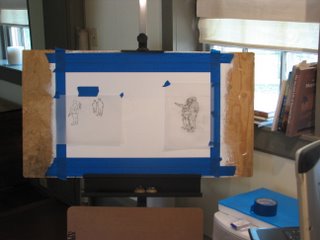
Positioning groups of figures using tracing paper prior to transfer to working surface.

Positioning groups of figures using tracing paper prior to transfer to working surface.
 Figures laid in with single tone and fore and middle-grounds developed using thin washes of color.
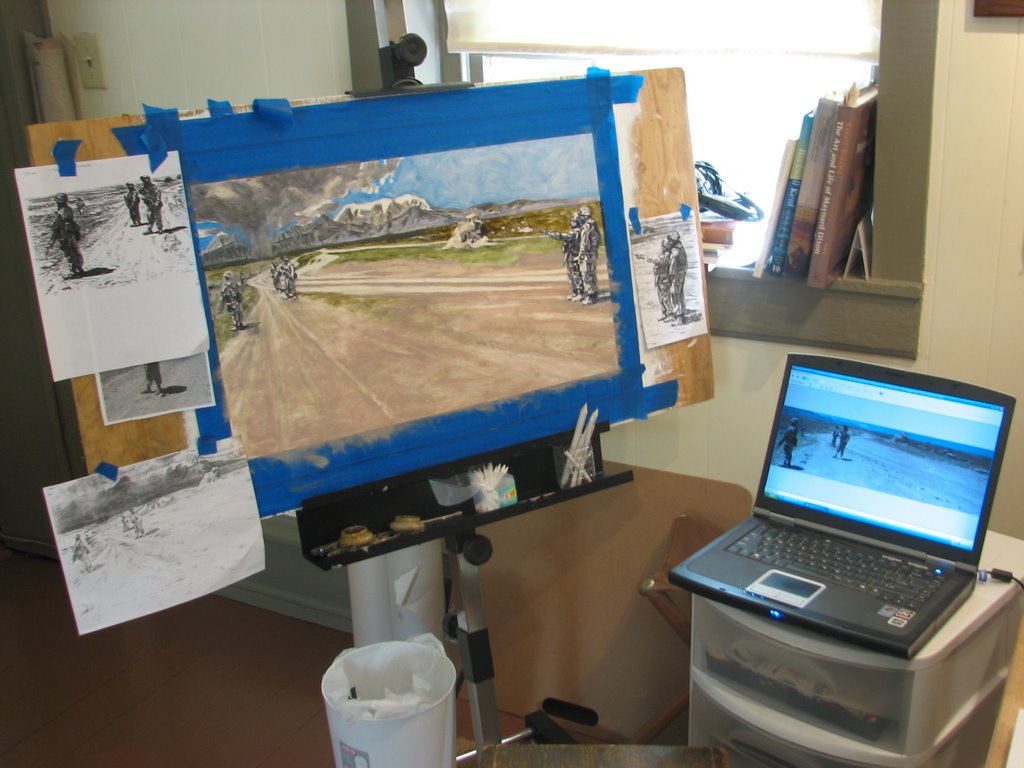 Background and sky fleshed out.
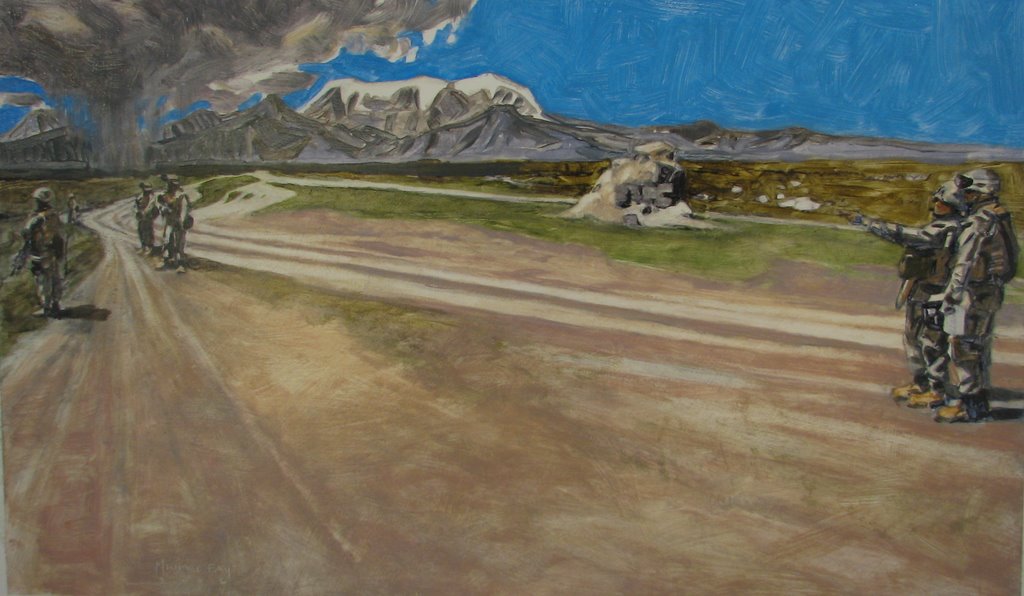 Figures finished. Storm and Stone:Study 23"x30"
This past week, between fielding e-mails and phone calls from a bevy of media folks and consulting with the Marine Public Affairs Officer at Quantico, I completed the first oil study for Storm and Stone. The Marine Corps was gracious enough to have extended me permission to talk to the press about my time last October spent with the Marine unit, K/3/1, implicated in the alleged Haditha incident. However, at the end of the day, I decided to decline the radio, newspaper and television entreaties, and focus on just doing art. No Marine officer, not even the Commandant, has gone on the public record about the circumstances surrounding this unfortunate and controversial event......I wasn't going to be the first. Plus, these news people seemed a little too desperate for anything, and what little I know would have surely ballooned up way out of proportion to fill an information vacuum; a vacuum that is currently swollen with enough second-hand twice removed conjecture and editorializing, sermonizing and demonizing. It was interesting to have had the opportunity to speak at length with Thomas E. Ricks of The Washington Post, Pulitzer Prize winner and author of Making the Corps.
On a sad note: I'd like to pay tribute to my Mom's companion of nearly 20 years, Andy Frantz. Andy passed away this afternoon of complications following a massive stroke a week and a half ago. During the last three years he struggled with the insidious assault of Alzheimer's Disease with dignity and an unfailing sense of humor. Andy was what we back home refer to as a salt of the earth Pennsylvania Dutchman. His passing will be mourned by my Mom, her seven grandchildren (who knew him as their Grampy Andy), and legions of friends in Allentown, Pennsylvania. Here's to you Corporal Andrew Frantz USA, 82nd Airborne Division...go easy my friend.
Sunday, June 04, 2006
To Every Thing There Is A Season
This article first appeared March 21, 2006 on the New York Times TimesSelect website. This material is copyrighted by The New York Times and Michael Fay.
Today I’m going to talk about the two things closest to my heart — the Marine Corps’ Combat Art Collection and my daughter.
On Friday I checked in off of post-deployment leave. For two weeks I had made the rounds of family and friends. My daughter is a freshman at a large university in Boston, and my leave happily coincided with her spring break. Being with her was the highlight of my time off. I don’t know who was more concerned this past fall and early winter, her or I. She was fearful about my being in a war zone, and I was in an absolute panic about her debut into the world of complete independence while I was half a planet away.
We’re somewhat adept at being apart. Since second grade, when her mom and I divorced, she’s had a primary residence other than mine. For most of her childhood she lived nearby, so we spent every other weekend and each Wednesday evening together. We worked on many science fair projects and book reports and enjoyed holidays and summer vacations at the Jersey shore. When she entered tenth grade, she and her mother moved to Maine. There was still Thanksgiving and the shore, but the geographical separation was hard, at least for me. Since 9/11 she’s endured four of my deployments. She wanted to spend her break with me and I was thrilled.
She didn’t want to hear gory war stories, and I didn’t quiz her about the usual messy freshmen year indiscretions — or if indeed there had been any indiscretions. We did a lot of shopping, and I was happily surprised by the eclectic mix of music on her iPod.Before she went off to college, when we took road trips I had to endure listening ad infinitum to two CD’s — “American Idiot” by Green Day and Good Charlotte’s first album. Now, her iPod is loaded with over 2,000 tunes, none by those two groups. We listened to everything from Sara Brightman singing Andrew Lloyd Webber show tunes and artsy Kate Bush-esque stuff to now-classic songs from 1960’s (The Byrds) and ‘70’s (The Romantics). She loves “Turn,Turn,Turn” and was amazed to learn that the lyrics by Pete Seeger come from the Book of Ecclesiastes in the Bible. Driving down from Boston we sang in unison, “That’s what I like about you…” I’m looking forward to turning her on to the real Kate Bush and eclectic stuff like the German group Kraftwerk.
Now, some history behind the Marine Corps Art Collection. There are approximately 7500 pieces of art in the collection. The works go all the way back to the founding of our republic and include everything from the first painting showing a United States Marine to rare recruiting posters. A good portion of the collection comes from the combat art program — from combat artists, both civilian and military — fielded by the Marine Corps.
The program dates back to a WWI Marine officer, John W. Thomason, an infantry officer who sketched for his own edification and turned his drawings and combat experience into a powerful illustrated book titled “Fix Bayonets!” Between the two world wars Lt. John Capolino produced historical paintings, primarily of current and past Marine Corps battles and operations.
During WWII, the Korean War and the Vietnam War, the combat art program produced thousands of images, both sketches and finished work, for the collection. Well-known living artists that have sprung from this tradition include Harry Jackson, Howard Terpning and Henry Casselli.
Following the Vietnam War the combat art program became a function of the Historical Division and was staffed by reserve Marines. There are currently two official combat artists, myself and Maj. Alex Durr, who’s presently en-route to Iraq. We also have a new artist, Kris Battles, who is processing back into the Marines and will come the third member of our team. A fourth Marine, Sergeant Jack Carrillo, is an active duty guy, who we've requested to come work for the Historical Division from time to time. His last assignment for us sent him out with a tank battalion during Operation Iraqi Freedom I in 2003.
This coming November the National Museum of the Marine Corps will be opening at Quantico, Va., and the artwork will be available for public viewing. A show of my artwork is scheduled to be exhibited at the James A. Michener Art Museum in Doylestown, Pa. in July 2007.
Why does the Marine Corps have an active fine art program? This question is often posed to me with a raised eyebrow, and is difficult to answer. The martial reputation and public perception of the Marine Corps is a powerful one, and in most of our minds heavily weighted in a direction away from anything remotely associated with art and culture. Admittedly, we Marines are often the culprits in perpetuating the popular image of the gruff anti-intellectual warrior. But in truth, the Marine Corps at its center is concerned with excellence and the values that inform and animate a free and open democracy.
In a free society art can exist for its own sake. In a military organization, which in many ways is a distinctly closed and undemocratic culture, the challenge to keep democratic values and attitudes alive is critical. Nations have succumbed to internal coups because their military culture lost sight of what they swore to defend in the first place.
One of the many ways the Marine Corps nurtures a healthy devotion to the core values of our American republic is through its combat art program. As I mentioned in my first post, Marine artists are sent into harm’s with one basic order: Do art. This official directive has no subject matter, medium, style or quantity attached. The Marines simply makes it possible for the combat artist to create from one of the most elemental visual sources — people and places in times of war. We marines who’ve been honored with the chance to be combat artists are completely free to follow our own artistic sensibilities
Today I’m going to talk about the two things closest to my heart — the Marine Corps’ Combat Art Collection and my daughter.
On Friday I checked in off of post-deployment leave. For two weeks I had made the rounds of family and friends. My daughter is a freshman at a large university in Boston, and my leave happily coincided with her spring break. Being with her was the highlight of my time off. I don’t know who was more concerned this past fall and early winter, her or I. She was fearful about my being in a war zone, and I was in an absolute panic about her debut into the world of complete independence while I was half a planet away.
We’re somewhat adept at being apart. Since second grade, when her mom and I divorced, she’s had a primary residence other than mine. For most of her childhood she lived nearby, so we spent every other weekend and each Wednesday evening together. We worked on many science fair projects and book reports and enjoyed holidays and summer vacations at the Jersey shore. When she entered tenth grade, she and her mother moved to Maine. There was still Thanksgiving and the shore, but the geographical separation was hard, at least for me. Since 9/11 she’s endured four of my deployments. She wanted to spend her break with me and I was thrilled.
She didn’t want to hear gory war stories, and I didn’t quiz her about the usual messy freshmen year indiscretions — or if indeed there had been any indiscretions. We did a lot of shopping, and I was happily surprised by the eclectic mix of music on her iPod.Before she went off to college, when we took road trips I had to endure listening ad infinitum to two CD’s — “American Idiot” by Green Day and Good Charlotte’s first album. Now, her iPod is loaded with over 2,000 tunes, none by those two groups. We listened to everything from Sara Brightman singing Andrew Lloyd Webber show tunes and artsy Kate Bush-esque stuff to now-classic songs from 1960’s (The Byrds) and ‘70’s (The Romantics). She loves “Turn,Turn,Turn” and was amazed to learn that the lyrics by Pete Seeger come from the Book of Ecclesiastes in the Bible. Driving down from Boston we sang in unison, “That’s what I like about you…” I’m looking forward to turning her on to the real Kate Bush and eclectic stuff like the German group Kraftwerk.
Now, some history behind the Marine Corps Art Collection. There are approximately 7500 pieces of art in the collection. The works go all the way back to the founding of our republic and include everything from the first painting showing a United States Marine to rare recruiting posters. A good portion of the collection comes from the combat art program — from combat artists, both civilian and military — fielded by the Marine Corps.
The program dates back to a WWI Marine officer, John W. Thomason, an infantry officer who sketched for his own edification and turned his drawings and combat experience into a powerful illustrated book titled “Fix Bayonets!” Between the two world wars Lt. John Capolino produced historical paintings, primarily of current and past Marine Corps battles and operations.
During WWII, the Korean War and the Vietnam War, the combat art program produced thousands of images, both sketches and finished work, for the collection. Well-known living artists that have sprung from this tradition include Harry Jackson, Howard Terpning and Henry Casselli.
Following the Vietnam War the combat art program became a function of the Historical Division and was staffed by reserve Marines. There are currently two official combat artists, myself and Maj. Alex Durr, who’s presently en-route to Iraq. We also have a new artist, Kris Battles, who is processing back into the Marines and will come the third member of our team. A fourth Marine, Sergeant Jack Carrillo, is an active duty guy, who we've requested to come work for the Historical Division from time to time. His last assignment for us sent him out with a tank battalion during Operation Iraqi Freedom I in 2003.
This coming November the National Museum of the Marine Corps will be opening at Quantico, Va., and the artwork will be available for public viewing. A show of my artwork is scheduled to be exhibited at the James A. Michener Art Museum in Doylestown, Pa. in July 2007.
Why does the Marine Corps have an active fine art program? This question is often posed to me with a raised eyebrow, and is difficult to answer. The martial reputation and public perception of the Marine Corps is a powerful one, and in most of our minds heavily weighted in a direction away from anything remotely associated with art and culture. Admittedly, we Marines are often the culprits in perpetuating the popular image of the gruff anti-intellectual warrior. But in truth, the Marine Corps at its center is concerned with excellence and the values that inform and animate a free and open democracy.
In a free society art can exist for its own sake. In a military organization, which in many ways is a distinctly closed and undemocratic culture, the challenge to keep democratic values and attitudes alive is critical. Nations have succumbed to internal coups because their military culture lost sight of what they swore to defend in the first place.
One of the many ways the Marine Corps nurtures a healthy devotion to the core values of our American republic is through its combat art program. As I mentioned in my first post, Marine artists are sent into harm’s with one basic order: Do art. This official directive has no subject matter, medium, style or quantity attached. The Marines simply makes it possible for the combat artist to create from one of the most elemental visual sources — people and places in times of war. We marines who’ve been honored with the chance to be combat artists are completely free to follow our own artistic sensibilities
Subscribe to:
Posts (Atom)