Monday, December 05, 2005

When the Foreign Legion's Just Too Far Away


After finishing the post about the mail call I got to work on another portrait. This is Private Reinier Koole USMC late of the Dutch Royal Marines and native of Aruba. It's a companion piece to the previously posted work depicting the personal driver for the CO of RCT-2. I used to joke with friends that the reason I joined the Marines was because the French Foreign Legion was just too far away. At the tender age of 21 someone had broken my heart, and having seen "Beau Geste" way too many times was a prime candidate for becoming the last man standing in a besieged fort out in the desert. The Marines are arguably the next best thing to the rigors of the Legion. In my case, the heart mended and the lovely girl in question went on to marry way better than she would have done with me. Here in Iraq I'm constantly aware of those Marines who hail from other lands. Some, like Pvt. Koole, came looking for adventure, and he's getting his money's worth. Whether he's living out some scorned lover runs off to join the Legion fantasy I can't say.

Mail Call!!!


Cpl. Tammara Kime USMC


Pvt. Matthew Sears USMC


Today word went out that there was going to be a MASSIVE shipment of holiday mail arriving on Camp Fallujah. All units were asked to send as many available hands as possible to the "working party". You gotta love what the Marines call the least agreeable of duties. At around noon, from the nearby post office, I could hear an energetic cadence of voices shouting out unit numbers. I grabbed my camera and digital voice recorder and headed in the direction of the noise. I found dozens of sweaty Marines and sailors, male and female alike, systematically sorting and tossing huge orange mailbags, overstuffed white and blue postal envelopes and heavily taped and addressed cardboard boxes. Each parcel found its way somewhere down the bucket line into a specific unit's conex box. It was pure poetry in motion. One Marines' voice, a lowly E-1 private from Grand Junction Colorado, rose enthusiastically above the others exhorting and entertaining the daisy chain of workers. Pvt. Matthew Sears (meritoriously promoted to his present rank for being 6 hours late from a 96 hour holiday pass) was the grand motivator of the festivities. Pvt. Sears' day job is as a mechanic on Amphibious Assault Vehicles, but on this hot Fallujah afternoon he reigned supreme over the festivities. But the heart and soul of the mail call was Cpl.Tammra Kime of Camp Lejeune, North Carolina. Cpl. Kime read and called out the unit address on every package as she hefted it into the arms of the first GI in the assembly line. Like an expert coxswain calling cadence she kept the mail flowing down the line with rhythmic efficency.

Sunday, December 04, 2005

Inviting the Shot.........


Here are two paintings by Winslow Homer that have been on my mind today. For those of you unfamiliar with Homer, you should know that he was a "special correspondent" for Harper's Weekly during our Civil War. A self-taught artist and native of the state of Maine, he brought a no-nonsense Yankee sensibility to his work that echoes yet down the corridors of American art. Parents, wives, children and sweethearts, then as now, had a great desire for some idea of what their loved ones were experiencing far off at war. Homer sought to satisfy that longing with images capturing a reality that few at home could even hope to imagine. Homer, placing himself out in the field, and utilizing his native talent and down-to-earth vision, gave his viewers a vicarious window into both the maelstrom of battle and the tedium of camp life. He elevated the mundane to the poetic, and humbled the faux heroic to simple truths.

One painting is titled "Inviting a Shot Before Petersburg". It shows a Confederate soldier standing defiantly with clenched fists upon the parapet of the rebel trenchline encircling the besieged city of Petersburg, Virginia. In the distance a puff of white smoke reveals the position of a Union sharpshooter. This painting captures and stretches into eternity the pregnant moment between life, and perhaps death. Here in Iraq the ground pounders, both Marine and soldier, patrol daily in the hopes of inviting these shots, of tempting the enemy and death into revealing their position. These are endless moments where death trudges beside you, a battlebuddy who at any moment might come over, tap your shoulder and ask for a light. Some have suggested that the soldier on the parapet has snapped under the strain of combat and has leapt up in a moment suicidal derangement. I believe otherwise. Homer was in the thick of things, and knew that troops will do what simply needs to be done sometimes, no matter how counter-intuitive it might seem. The other painting, "Veteran in a New Field", shows a post-war soldier harvesting a field of wheat. In the foreground lie his blue uniform jacket and canteen, clearly marked with his old unit's insignia. His back is to us as he works his way forward through the chest high field, perhaps triggering in him memories of other fields crossed; where another reeper cut down comrades all around him. Homer's genius anticipated the reality of veterans carrying their experiences back with them; of everyday things and experiences never being the same again. His pictures, in the simple design format of a central figure in the middle ground, trumpet the supremecy of the individual ordinary combatant. Aaron Copeland's "Fanfare for Common Man" reverberates in these iconic images.

Sunday Thoughts


Here's a drawing I did yesterday of a young Marine sergeant. He's the personal driver for the Commanding Officer of Regimental Combat Team Two. Normally, back in the rear with the gear, this kind of assignment would be safe and cushy, but out here it's not. The Colonel in command of RCT-2 leads from the front, and frequently visits his units spread out across the meanest parts of western Iraq. This is the face of someone exposed everyday to every imaginable way of being killed.

Yesterday, while doing this drawing, I recieved an e-mail from the father of a young Marine lieutenant who was killed in the line of duty. He was gracious enough to include part of the last letter his beloved son wrote him 5 days before he fell in battle. I'm not going to give you the young man's name, yet I ask as you read these cherished words to remember that he is not some anonymous un-named source, he was flesh and bone, and once full of hopes and the kind of grit and determination most men only dream of having. There are politicians back home trumpeting a "cut and run" policy. I don't know what their sources are or what their politial motives might be, but they weren't this lieutenant's, nor mine.

"The Marines have worked very hard and have done a phenomenal
job, as have the Iraqi Security Forces attached to my Platoon.
We've seen evidence of the cowardice and ruthlessness of the
enemy and it only reinforces my belief that these insurgents
must be systematically killed or captured. The Iraqi people
deserve a life free from the influences of these
terrorists--and they are terrorists. People that commit the
kind of atrocities that these terrorists do deserve nothing
less than the most painful deaths imaginable.... If you walk
through these cities and see how poor and terrified the Iraqi
citizens are of terrorists, and how thankful they are that we
finally came to their cities, you could not possibly consider
doing this job incompletely.... Have faith in what the Marines
are trying to do here. I'm constantly surrounded by the finest
young men America's got. We'll be just fine...."

I don't mean to be morbid. This is Sunday, and I am thoughtful of the role death plays in reminding us to live, to truly live. Death, as Carlos Castaneda's character the Yaqui shaman Don Juan instructs us, is not an enemy but a friend always whispering at our left shoulder, "live". And grief, to paraphrase Elizabeth Kubler-Ross, "is a messenger that tells us that we have loved well". Kubler-Ross also reminds us that for those who have neither loved or lived well death always comes too soon. So go grab the one you love and go live this day. Amen

Saturday, December 03, 2005

My Protesters

This is the newspaper article that I mentioned in the previous post. I have no quarrel with protests, or liberal progressive thinking for that matter. However, I'm finding that the left, like many of their protagonists on the far right, are stuck in their own little retrogressive groves.

ROCKLAND - Free speech clashed with free expression on a downtown street corner Saturday as artists opposed to war protested the showing of combat paintings of Marine Sgt. Michael Fay at the Farnsworth Art Museum. Sgt. Fay stood ramrod straight when confronted by the small group of protesters upset with the Farnsworth for exhibiting his paintings of combat forces in Iraq and Afghanistan. The afternoon sun reflected off the combat ribbons pinned to his green uniform, and the red chevrons on his sleeves glinted in the finish of his spit-shined shoes as Fay listened to his challengers.

"The protesters objected to the show's content and what they claimed was the museum's "implicit support of war." They said a more balanced show would include images of civilian deaths and mass destruction. To represent one facet of military life in combat zones without placing it in the context of the true costs of war displayed a lack of sensitivity, they said.

"....We are fighting an illegal and immoral war," Suzanne Hedrick, 73, of Nobleboro told Fay. "Without another viewpoint, without the faces of the victims and the ruining of the country, I'm deeply concerned."

"....Fay spent two years in the Afghanistan and Iraq war zones, armed only with a pistol, camera and sketch bag. Some of his work was done in the field, other pieces created in his studio from images he brought home. Fay retired from the Marines in 2000, "but 9-11 changed everything," he said. Fay, who lives in the Washington area, joined a Reserve unit and was posted to the combat zones.

"These in no way, shape or form glorify war," said Fay. "It has nothing to do with anybody ever pulling a trigger. I'm an artist; we do art."

While critical of his subject matter, the protesters also were upset that Fay came to the show in full-dress uniform. They said it indicated that he was on official business and promoting war.

"The fact that he would come not dressed as an artist, but as a Marine is an affront," said Natasha Mayers of Whitefield. "I'm for real expression that's not paid for. This guy is paid for, he's been a Marine all his life, and this is a military point of view. The day-to-day part of war, which we can't imagine, is what we need to see. We need to see images that tell us the truth."

Friday, December 02, 2005

Notes on Being a Jarhead Artist


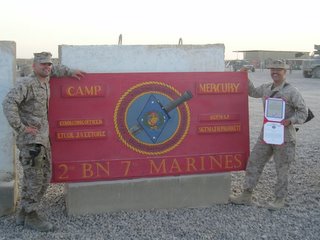
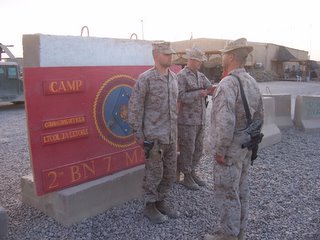
Yesterday, December 1st, was a very special day for my family and myself. My nephew, 1st Lieutenant Richard "Joey" Fay promoted me to Warrant Officer in the United States Marine Corps. This promotion, though very satisfying professionally, is more gratifying in a profoundly timeless way. My father, and Joey's grandfather and namesake, was a young lieutenant with the very same unit, 2nd Battalion/7th Marine Regiment, during WW II. Joey performed the promotion ceremony flawlessly in front of 2/7's Command Post entrance at Camp Mercury, adjacent to Camp Fallujah.

What does it mean to be a Marine? To be an artist in the Marines? There's no simple answer for me to give. The best I can do is supply you with a couple little windows into my psyche.

First, I grew up listening to stories, tales and yarns about the Marines. My Dad was "Old Corps";a pre-WW II Marine. There is a powerful magic in family lore, in stories told and passed down from generation to generation. My father was a poor Irish Catholic kid from Boston. His father died in 1929 at the start of the Great Depression and left a family of six for my grandmother, Gammsy, to raise. Their main meals were often fried bologna sandwiches and something uniquely Irish called bubble and squeek. A sinister, the nuns at school would start his day by removing a sock and putting it over his left hand; the hand of the devil. This only made him ambidexterous. In the early summer of 1938 he, the youngest son, realized he wasn't going to enter the priesthood. Or, as he eloquently put it, "there was a red-headed girl down the street and, well...I knew I'd never be a priest." My father was as handsome a blue-eyed Black Irish tenor with the gift o' gab as you'd ever hope to meet this side of Dublin. Under his high school yearbook picture are the words "lady killer". In early summer of 1938 he went off with the Civilian Conservation Corps to a CCC camp in the wilds of Montana. This inner-city Mick thrived on the rigors of planting trees and clearing fire lanes. In the early Fall of that same year a team of Marine recruiters visited the camp and hand selected two young men to enlist. One of them was my father, and on October 4th he signed on at the recruiting station in Denver, Colorado. Three years later, after having seen half the world, he was a 21 year old lieutenant leading Marines in the jungles of Guadalcanal. Twice he "went to Kansas City and saw the elephant" (slang for being wounded in combat), survived a bout with malaria, and successfully kicked clinical morphine addiction. The essence of these experiences are summed up in my father's oft quoted favorite piece of poetry:

Out of the night that covers me
Black as the pit from pole to pole
I thank whatever gods may be
For my unconquerable soul

"Invictus" by William Ernest Henley

My father was also a gentle giant unhardened by his wartime ordeals. He was famous for his sense of humor and encyclopedic knowledge. Among the books in his small library were everything from Kahil Gibran's "The Prophet" to a footlocker packed with pulp science fiction novels. His was the voice, belting out the national anthem, that rose majestically above the crowd at any high school sports event;much to the embarrassment of my teenage self. Wearing only a t-shirt in the middle of winter, he would soak himself to the skin shoveling snow. If an adult was using foul language with children present, he was the guy who would straighten them out; with words, or if necessary, a quick right to the jaw. Neighborhood buddies knew it was my Dad who'd pile everyone into our big green Pontiac stationwagon and go searching for the perfect toboggan hill after a fresh snowfall. I can still see him in the garage, a sweat flecked Pall Mall cigarette clenched in his teeth, working on some happy homemaker project. He knew his life had been blessed. He escaped the poverty of the Depression and the veil of prejudice that overshadowed his childhood in Boston ("N.gg..s and Irish need not apply" regularly appeared in Boston Globe help wanted adds). He married the woman of his dreams and sired three sons, while all the original Marines in his company, save a dozen, never lived to do so. Even in his dying days he would call this "the best of all possible worlds."


These rites of passage tales stuck to my bones, and when I was a 21 years old, after dropping out of three colleges and managing to do little more with my life than grow hair down to my keester, I realized that I needed just that kind of experience. So, this former high school class salutorian left for the world's finest finishing school for young men, Marine Corps Recruit Depot, Parris Island, South Carolina. I surgically removed myself from a safe middle-class white bread cocoon. There, on August 23, 1975, standing on yellow footprints in the suffocating heat of a Carolina night with a Marine drill instructor screaming in my face with demonic intensity, my rite of passage commenced with a vengenance. It has, as Robert Frost would say, made all the difference. My road less traveled has been tread for many miles in combat boots.

There's a very politically incorrect racial joke who's punch line I'm not going to share with you. Sorry, however, I am going to use the set-up part of it. Here goes....A zebra goes to heaven and standing before Saint Peter asks one simple question, one which he hopes the good saint, or God himself will answer. "Was I a black zebra with white stripes, or a white zebra with black stripes." My version of this is probably going to be " Saint Peter, was I a Marine who was an artist, or an Artist who was a marine?" This past February I had my first museum exhibition open at the Farnsworth Museum and Wyeth Center in Rockland, Maine. Wow, was I thrilled! I even had my own protesters! One of the many things they took exception with was my appearance, or as one of them complained to the local press, "I'm offended that he would come dressed as a Marine, and not as an artist." Regretably, I had left my black beret, ragged blue jeans, tweed jacket, black turtleneck and ear-ring at home. Actually, other than the beret, this is exactly the case. I, and many others found it quite ironic that the protesters, members of the very liberal Maine Alliance of Visual Artists, would be dictating what another artist should wear. (Little did they know that the Marine standing before them in his dress uniform had tested out on personality profile quizes as a "cultural creative".) Life never ceases to amaze! I am very aware that I stand astride two very different worlds. Carl Jung, the great Swiss psychiatrist, writes at length about a concept he calls individuation; the never ending process of becoming an authentic human being. (This topic is also taken up by Gail Sheehy in her best seller "Passages") What he has to say is particularly meaningful to men in mid-life, a club I more than belong to. There are, according to Jung, two distinct paths. Most opt for what he calls the "retrogressive restoration of the persona"; of electing to settle into a stereotypical pattern of behavior avoiding mental, spiritual or psychic challenges. On the other path we stay in the "tension of opposites", and thereby continue to grow to the end of our days, and perhaps beyond. I will allow you dear reader to decide which path yours truly is on, and whether I'm a black zebra with white stripes, or a while zebra with black stripes. I leave you with a little Emily Dickinsonish poem of mine:

I am color subtle, muted, tertiary
Think not to know me with palette simple and primary.
For I am twilights November,
And gloam in February

Tuesday, November 29, 2005

Artist's Statement

Here's the "Artist's Statement" from my current exhibition "Fire and Ice: Marine Corps Combat Art from Afghanistan and Iraq"

When I tell someone I'm a combat artist for the United States Marine Corps three questions are invariably put to me. First, what is a combat artist? Second, what does combat have to do with art? And finally, why would the Marines Corps, of all organizations, have artists? The first question is usually asked with great curiosity, while the final question is often posed with a tone of incredulity. The answer to the first question is simple. A combat artist is an artist who goes to combat. This is no more and no less than a landscape artist going outdoors to find the visual and experiential content for their work.

The response to the second query involves a short art history lesson. Art and combat have been wedded since time immemorial. Whether it's a 5,000 year old pictograph painted onto a cave wall in Montana depicting a primitive spear brandishing warrior, the evocative 3rd century B.C. Greek statue entitled "The Dying Gaul", or Dutch master Rembrandt's painting "Nightwatch", we are talking about combat art. There is a reality and immediacy in each of these pieces that speaks of the individual artist's direct experience of war and warriors.

Many other well-known figures in art history have chosen to render images of war drawn from their personal experiences. Goya produced a dramatic set of etchings based on the horrors inflicted during Napoleon's occupation of Spain. Winslow Homer followed a Union sniper out into the field and his resulting image, "The Sharpshooter", is one of the most indelible images of the American Civil War. Egon Schiele sketched sickly Russian POWs with great compassion while serving in the Austrian Army during World War I. During that same war, John Singer Sargent painted the seemingly endless lines of gassed British soldiers. All of these body of works qualify as combat art, and at the same time they are each universally recognized as essential elements in the critical understanding of Western Art as a whole.

The third question, the one often posed with a raised eyebrow, is the most challenging to answer. The martial reputation and public perception of the Marine Corps is a powerful one, and in most of our minds heavily weighted in a direction away from anything remotely associated with art and culture. I recognize this stereotype is difficult to surmount. Admittedly, we Marines are often the culprits in perpetuating the popular myth of the gruff anti-intellectual warrior. But in truth, the Marine Corps at its center is concerned with excellence and the values that inform a free and open democratic society. In a free society art can exist "per se", for its own sake, with no other justification than to bear witness to the truth of the individual artist. In a military organization, which in many ways is a distinctly undemocratic and closed culture, the challenge to keep democratic values and attitudes alive in critical. Many nations have succumbed to internal coups because their military lost sight of the very thing they were tasked with defending in the first place.

One of the many ways the Marine Corps nurtures its devotion to the core values of our American republic is through its Combat Art Program; a program that cultivates art for its own sake. Marine artists are sent into harm's way with one basic order, do art. This official directive has no subject matter, medium or quantity attached. The Marine Corps simply makes it possible for the combat artist to create from one of the most elemental visual sources, people and places in time of war. We Marines who have been honored with the opportunity to be combat artists are absolutely free to follow our own creative instincts. Three well known practicing civilian artists who have emerged from this tradition are Howard Terpning, Harry Jackson and Henry Casselli. The Marine Corps' 7,500 plus collection of combat art stands in eloquent testimony to this vision, and is a credit to not just the Marines, but to America itself.

My own artistic impulse is a naturalistic one; to render as close as possible the reality of what is before me in the context of my own experience. As a beneficiary of the creative sensibilities championed by Winslow Homer, Thomas Eakins and Andrew Wyeth, I see a central goal of art in the elimination of stereotype. My art articulates what is true and real about the actual experience of war and warriors. My intent, especially in view of current events, is to give people another insight into this unfolding drama called the War on Terrorism.

It is also my hope that my work, though grounded in realism, is more poetry than prose, and more art than journalism. I do not want my presence in these pieces to be distilled away. I was there, in the heat, watchful and tense at the beginning of a dawn raid, surrounded by children at the edge of a soccer field littered with live mortar rounds, and bouncing down an Afghan highway pocked with shell holes and bordered by minefields. I have looked into the weary campfire lit faces of my fellow Marines in unnamed places and felt time suspend itself, and in that moment found myself wondering who's faces are these; Union soldiers before Fredericksburg? Roman legionnaires during the 4th watch of the night? Or, Greek hoplites facing Troy?

It has often been my field experience, while doing a sketch or a watercolor amid my fellow Marines, that my mere presence doing art has a positive impact, even during the most trying circumstances. This consequence was something I simple had never anticipated, and it has made me acutely aware of the humanizing effect doing art can have in the midst of war, one of the most de-humanizing of experiences.

The title of this exhibition is "Fire and Ice". Although this is the title for one of the works in the show, it actually refers, at a deeper level, to my personal experiences in Afghanistan and Iraq. These are experiences of extremes; from the numbing cold of Kandahar in January, to the searing 130 plus degree heat of Babylon in late June; from the deep and engaging hospitality of individual Iraqis, to the unpredictable and faceless violence of roadside bombs; from the relative comfort of base camps to inhospitable desert nights spent sleeping on a ground teeming with black scorpions and camel spiders. The list could go on and on.

When I titled the piece "Fire and Ice" I was also conscious of Robert Frost's poem of the same name. A poem that muses somewhat darkly on the two extreme possiblities of the world's end, in fire or in ice.

Walk By Moonlight


Today I produced a watercolor from memory depicting the night movement of Fox Company 2/1 to its assualt position before the city of Ubaydi, Iraq in the early morning hours of 14 November. The company began this 3 kilometer march to the edge of Ubaydi at 0330 in the morning. The moon was up and full; the night air was bracing and very still. Each Marine, heavily laden with gear, weapons and ammo was a ghostly figure trailing a silvery cloud of dust. Marines in the distant line of march faded into a delicate veil of "moondust", slang for the talcum-like powder that the soil of Iraq quickly disolves into under the crush of combat boots and tank treads. The only sounds to be heard were the occasional squeak of a backpack harness, quiet coughs and distant roosters. The ankle deep moondust deadened the Marines' footfalls. We arrived at our positions opposite the town at about 0530, just as morning prayers were being sung in lilting Arabic from the minaret of the main mosque off to our left. The town itself was illuminated by both moonlight and the ubiquitous flourescent lights that grace every building in Iraq.

21 Going on 45


It's been about a week since I returned from the field. Here's a drawing that I finished back in my studio. It was started early one chilly morning in Old Ubaydi, but the young Marine I was sketching had to suit up and go on patrol before I got little more than the outline of his fleece cap done. None-the-less, I left the barely started piece in my sketchbook. Yesterday, when I was just about ready to tear it out, I stopped and put pencil to paper. The muse, as artists like to say, was with me, and this face alighted on the page. It's not the literal face of the original Marine, yet at another level it is. A significant number of the Marines in Fox Company 2/1 are over here on their third tours. A number of those third tour Marines were "short-timers" with not enough time left on their contracts to deploy a final time. Yet they elected to extend their enlistments to return with their buddies, and lend their seasoned expertise to the newbies.....and they did this as lance corporals, knowing that it would be a third road-trip of humping, patrolling, fighting and possibly dying. These lance corporals are the marrow of the Marine Corps. These are the rough men standing watch and doing violence while we sleep. These are the 21 year olds who feel like they're going on 45. You'll never see them in the mall with baggy trousers hanging off their butts and baseball hats on sideways again.

While I was with Fox Company they lost seven Marines KIA (killed in action). One of them I was blessed with the opportunity to have gotten to know, and in my capacity of oral historian (secondary job to combat art) interview. His name was 2nd Lieutenant Donald Ryan McGlothlin of Lebanon, Virginia. Lt McGlothlin was the best of the best. He led from the front and was loved by his Marines. He was high school class valedictorian, Eagle Scout, and Phi Beta Kappa at the College of William and Mary.

Thursday, November 24, 2005

The Mundane and the Murderous


"People sleep peaceably in their beds at night only because rough men stand ready to do violence on their behalf." George Orwell


Combat is a paradoxical dish whose recipe asks for generous dollops of the murderous garnished with a few dashes of the mundane. I was with Fox Company, 2nd Battalion of the 1st Marine Regiment from November 8th through the 19th for Operation Steel Curtain. These were 12 uninterrupted days and nights of combat against a devious and determined foe well apprised of our intention to do them harm. The local population was informed in no uncertain terms 24 hours ahead of time that the Marines would be attacking the following morning. There was no element of surprise. Civilians had to be taken into consideration and given the opportunity to exit from neighborhoods generously salted with foreign fighters; neighborhoods that would shortly boil over into lethal killing zones. Yet, even in the midst of the carnage Marines sandwiched everyday activities into the chaotic mix. Activities such as shaving, burning trash, sharpening knives, joking with buddies, reading paperbacks, playing chess with Iraqi soldiers, and writing letters served as simple punctuation marks between greater paragraphs of violence. These Marines even made time to celebrate the birthday of the Marine Corps, November 10th, with near-beer, steak and a slice of cake. Many greeted each other with a cheery "happy birthday Marine". An Associated Press writer, Jacob Silberberg, remarked to me that these young Marines,in the world of e-mail, must be the last people writing, reading, and longing for letters, and the only ones of their generation reading books for just for the sake of reading.

Today is Thanksgiving Day. I am thankful to be alive. I am thankful for my beautiful daughter, Ainsley, and a loving and supportive family headed by my gorgeous Mom. I am grateful to be a part of this noble cause, and to be surrounded by the finest young men and women I shall ever know......rough men all. Include them in your prayers and thanksgiving.