Monday, February 20, 2006

15 Minutes of Fame on Tuesday

We departed Kuwait in the early hours of Wednesday, the 15th. A convoy of comfortable buses transported us from Camp Victory to the jumping off point for the chartered flight that would wing us home. There were the usual hurry up and wait moments, but spirits were high and the delays taken in stride. Our aircraft was a wide body civilian jet, and I had my first taste of being an officer; I got a seat in first-class.....NICE! Among the officers and senior NCOs sitting in luxury was a private first class. One of the gunnery sergeants orchestrating the seating went to the main cabin and asked for a volunteer. Initially no one responded, but a lowly PFC raised his hand and was rewarded with the last open seat in first-class.

Once airborne we learned that there would be a brief lay-over in Shannon, Ireland. My great-grandfather came over from the Emerald Isle in 1892, and the joy of heading home was heightened all the more by the realization that I would being setting foot for the first time on mother soil. We flew into Shannon before sunrise. As we descended beneath the clouds far below a lighthouse's rotating beacon fanning out across the ocean caught my eye and I felt my heart, in the words of James Joyce, "softly falling into the dark mutinous Shannon waves".

The last couple days, courtesy of jet lag, have been a bit of a blur. Come this Wednesday our post-deployment processing will be completed and myself and travel companion, LtCol Craig Covert, a Marine Corps historian, will be returning to Quantico. My family has a welcome home party planned on the 25th for my nephew Joey and myself in our hometown in Pennsylvania. Joey, a 1st lieutenant with 2nd Battalion, 7th Marine Regiment, returned from Iraq back the end of January. As you can imagine, there is a great extended family of kith and kin breathing a collective sigh of relief.

On Friday Mike Phillips, the Wall Street Journal reporter I traveled with, informed me that an article he penned about yours truly is going to appear on the WSJ's page B-1 on Tuesday. So, I've got 15 minutes of fame to look forward to.

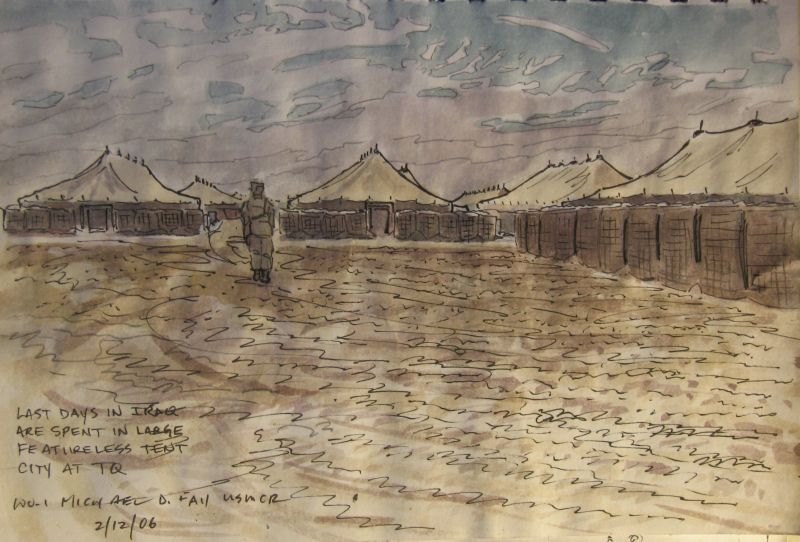
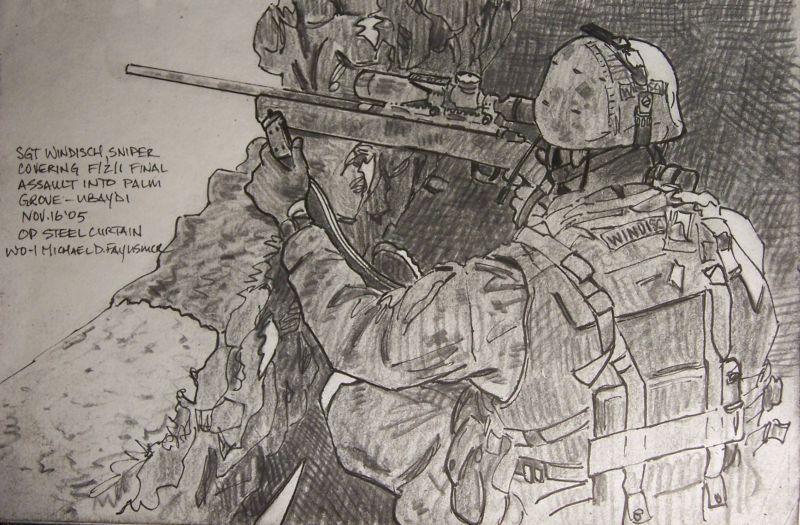
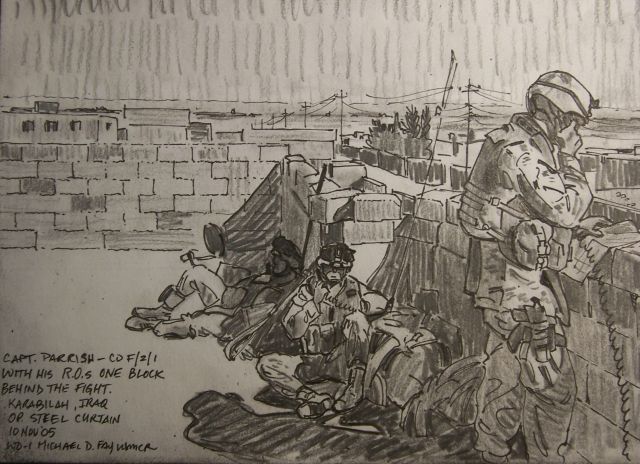
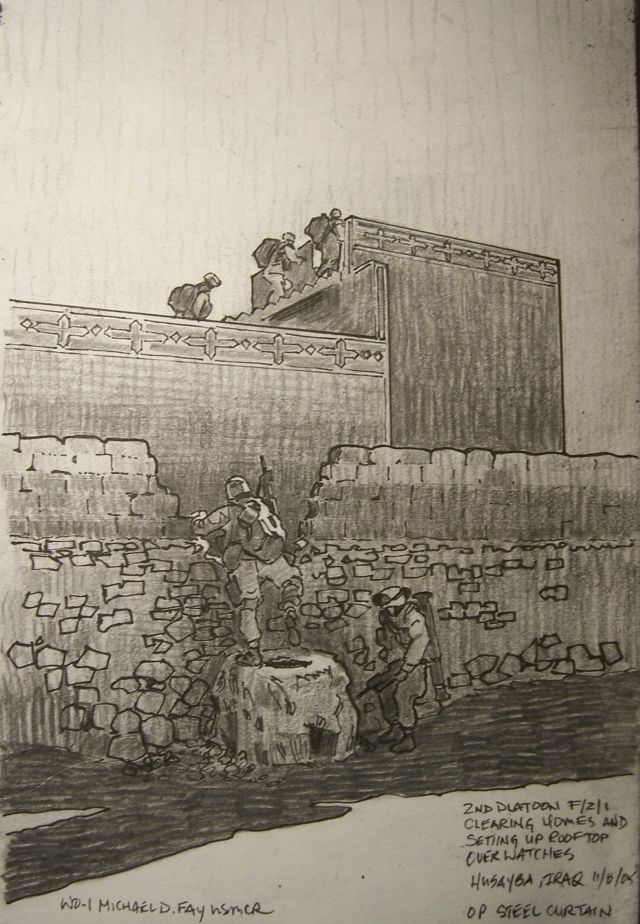
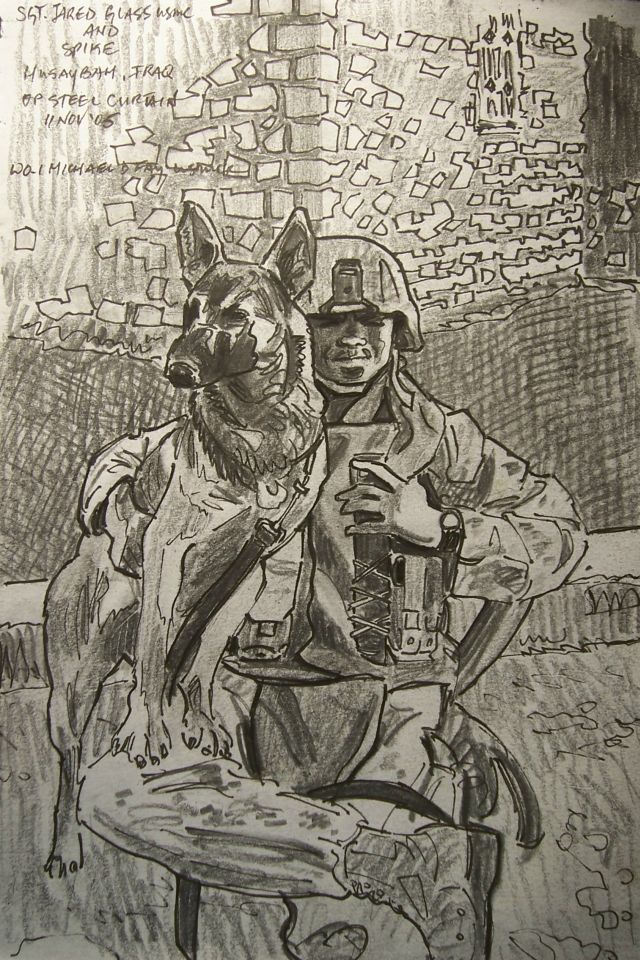
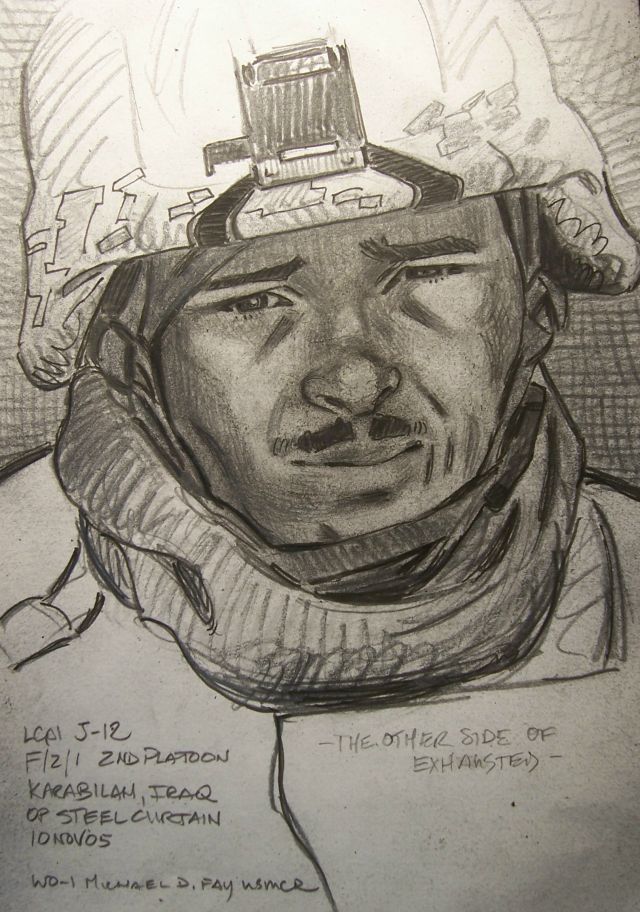
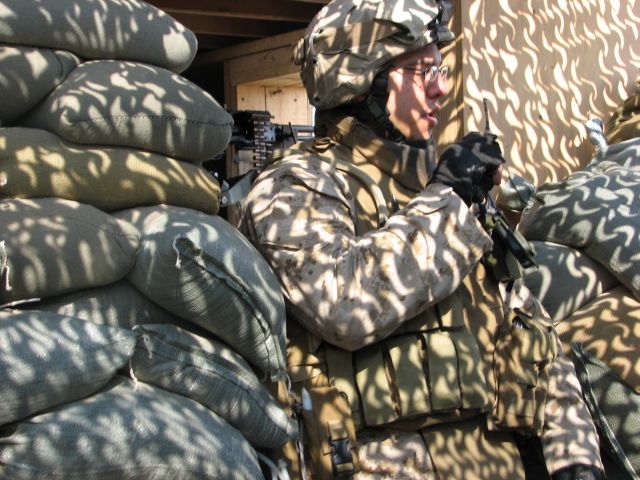
Here are the final pieces I produced in Iraq. I find myself already missing the exhausted resolute faces of fellow Marines, the scenes of commraderie and the rows of humble HESCO barrier encased tents.


Monday, February 13, 2006

Don't Sell the Farm Ray

We're out of Iraq and spending a few days de-compressing in a large transient tent city in Kuwait called Camp Victory before making the final leg of the journey stateside. Our arrival was in the wee hours of the morning and we we're greeted by comfortable buses. The stacks of seabags and backpacks were trucked right to the front of our hooch. We only had to drag them thankfully a few yards to our racks, dig out sleeping bags and collapse. Our flack jackets are now packed away and ammunition turned back in.

I'm writing this in a cozy, and I do mean cozy, internet cafe at the "Paradise Sands" USO center. This large otherwise non-descript building is awash in peaceful atmospheric lighting and comfy IKEA furnishings. If you've ever been in an IKEA store then you've probably seen a glass case with a pneumatic contraption making a kaa-shish sound over and over again flexing their signature easy-chair. Well there are lines of those chairs facing a couple big screen TVs. In the center of this cavernous space are piles of overstuffed pillows piled on top of matching sofa size cushions. I can hear the sound of dice rattling around in a cup coming out from a huddle of Marines playing a game of Phase 10. Along the perimeter are groupings of low over-stuffed sofas worthy of an episode of "Friends". Overhead are hanging playful Alexander Caulder mobiles gently turning in the air. You have to take your combat boots off when first entering and folks are padding about the carpeted floor in stocking feet. I feel like I'm back in kindergarten. God Bless the USO...this place feels a little like a mythic place that's on all our minds...HOME.

Those of you who've been gracious enough to follow my journey can probably guess my politics. I've tried to stay off of that soap box. If you ever read Victor Davis Hanson you'll get a pretty good idea where I stand. When 9/11 happened I was a card carrying dyed in the wool liberal registered Democrat. The religion stamped on my dogtags was Unitarian. Progressive ideas and thinking still inform alot of my core values. So, in many ways I, like alot of you, resist being labeled. But unlike alot of you and many very liberal friends, I have had the benefit being out here on the front lines in the War on Terrorism. I'm like the brother-in-law of Ray Kinsella in the movie "Field of Dreams" who, when finally seeing the ball players, speaks out of his epiphany those immortal words, "don't sell the farm Ray". This is a good fight. It is worth our blood and treasure. Let's not sell the farm just yet.

Tuesday, February 07, 2006

Two For the Road

*Click on images to enlarge


All good things must come to an end. This sojourn to Iraq is quickly drawing to a close and Friday night I'll start my return trip to the land of the big PX. For a final time an ASR number will be scrawled on the back of my left hand. In the darkness one last "seabag drag", weighted down with ALL my gear, into the back of a waiting helo. The dark expanse of Iraq will glide below us. Into memory will fade golden fragments of light spilling out from windows and doorways of Iraqi homes. A strand of silvery beads coiling across the landscape marking the midnight path of a coalition convoy will disappear like a wisp of smoke. I suspect I'll feel both drawn home and wanting to stay. I wonder if there is word for this, a word like bittersweet; a word that captures the tension of opposites. I've just lived five months in a world populated by real men and women engaged in what the philosopher and historian Victor Davis Hanson calls "muscular idealism". Individuals who know what Stanley Crawford, the author of A Garlic Testament meant by the "pound weight of the real at ground level". Something in me is wary of the unreality that awaits me back home. I will walk the streets of my beautiful little Virgina river town in the quiet of an early spring evening to my favorite coffee shop unarmed. There won't be the staccato sound of distant gunfire, or the deafening crack of a cannon followed by the sound of an artillery round splitting the air with the intensity of a raging locomotive. I'll make a visit to the mall to replace my scratched up spectacles and have no urgent concerns about the crowds of civilians or the cars and pick-up trucks driving where ever they like. In the mall and at the coffee shop there will be conversations about who said what to who, plans for the weekend, job prospects, complaints about the boss and a plethora of subjects that I fear will strike me as inconsequential and banal. Will I jump at the sound of a car backfiring or a door slamming? Will I have to suppress the urge to tell some twenty-something-college student with his hat on sideways smoking a clove cigarette to please stop whinning about Econ 101? Will I hear the far keening of the pipes? I imagine I will.

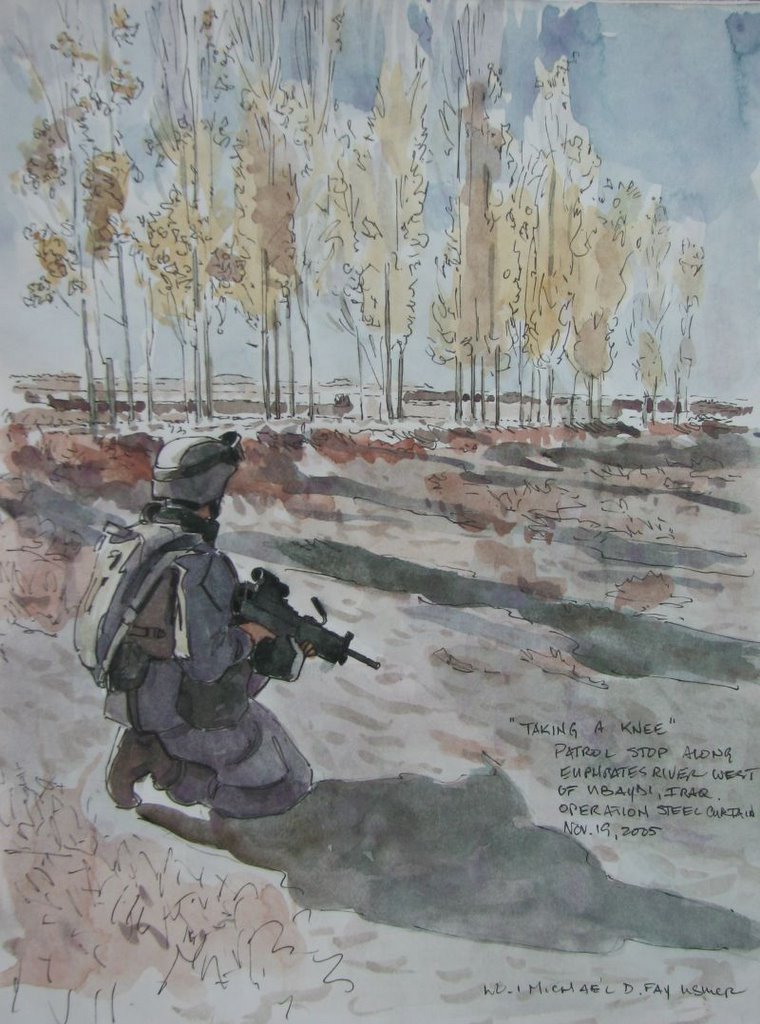
Here are two artworks for the road. A nameless Marine taking a knee looks out across the broad expanse of Iraq. The buffer zone between every single one of us and the terrorists starts about two hundred yards in front of him. The terrorist knows what a good shot he is and keeps a wary distance. But more than that, they know this young American, barely out of high school, given the chance, will kill him at any distance surely as God made little green apples. They know they are up against the greatest warriors on the planet. These are the civilized world's name takers and heartbreakers. Somewhere this kid from your hometown learned to love his country and his brother Marines more than himself. Somehow this kid from your son's 2nd grade class decided to act on the belief that there are some things bigger than ones self, ideas that both require and are worthy of his blood and treasure. This young man from down the street who delivered your morning paper and had a crush on your daughter knows who he's willing to die for, YOU. Three I knew did just that, LCpl Deeds of Mississippi, Cpl Rogers of Oklahoma and Lt McGlothlin of Virginia. Their blood, their last full measure is now mixed forever with the soil of Iraq. They lived and breathed a life where words like courage, honor and country were not strangers in town. The other is a portrait of Lance Corporal Lucas Turchich. It's based on a photo I took of him during a fifteen minute pause sandwiched between assaults in Husayba, Iraq. This is one of the "rough men" willing to do violence on your behalf. Sleep well. He's out there on watch tonight.

I'll be making more posts in the near future. After a couple weeks of leave with my daughter it'll be into the studio and the creation of finished watercolors and paintings. There is also a whole series of photo "abstractions" that I plan on posting. Iraq was visually rich in wonderfully textured and distressed surfaces and objects. Thanks to all of you who've visited me over the past five months. Semper Fi.

You can have your Army khakis, you can have your Navy blues
But I’ve a different fighting man to introduce to you
His uniform is different than any you’ve ever seen
The Germans called us devildogs, our real name is Marine


We were born on Parris Island, the land that God forgot
The sand was 18 inches deep, the sun was blazing hot
We get up every morning way before the sun
And run a hundred miles or more before the day is done


Over a million have come and gone who’ve called themselves Marine
We live by the motto “Semper fi”, let me tell you what it means
Always faithful to our nation, and faithful to the Lord
But first of all we’re faithful to our comrades in the Corps


We died on the beach at Guadalcanal and we died in Vietnam
We died in the mud at Belleau Wood and we died in Lebanon
And when we got to heaven Saint Peter we did tell
Another Marine reporting sir, I’ve served my time in hell


*Traditional marching chant from Marine Corps Boot Camp


The Things They Live By


I've included a link below to a site where there's a music video called "On My Watch Tonight". It's written and performed by a Marine, Mike Corrado. I hope you check it out. Oh, and have box of tissues handy.


http://www.mikecorrado.com/music-3.html

Saturday, February 04, 2006

By the Twos

*Click on images to enlarge


From this day to the ending of the world,
But we in it shall be remembered-
We few, we happy few, we band of brothers;
For he today that sheds his blood with me
Shall be my brother.
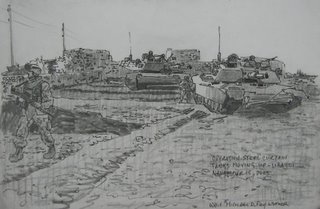

M1A1 Abrams Main Battle Tanks, Old Ubaydi
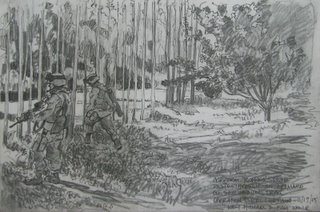

Corporal Koppes' Patrol, Ubaydi
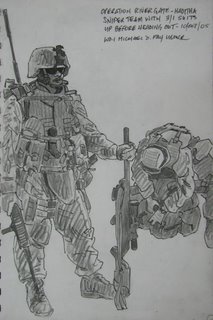

Sniper Team Gearing Up
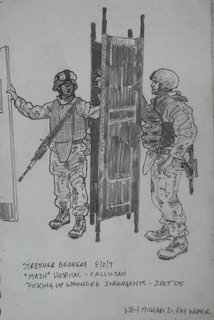

Stretcher Bearers
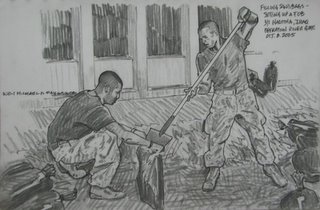

Filling Sandbags
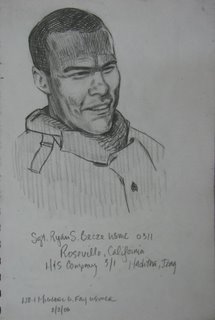

Sergeant Ryan S. Becze USMC
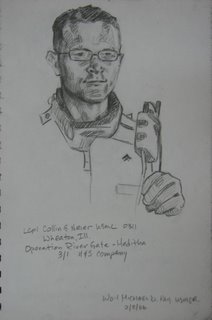

LCpl Collin G. Neier USMC
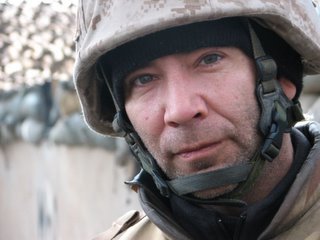

Pat Dollard, Neo-con Gonzo Documentarian
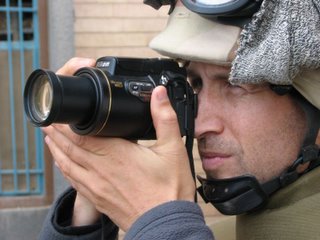
Michael Phillips, The Wall Street Journal

Là á Bhlà ir's math na Cà irdean
Friends are good in the day of battle
(On the memorial stone of the 51st Highland Division at St Valery)


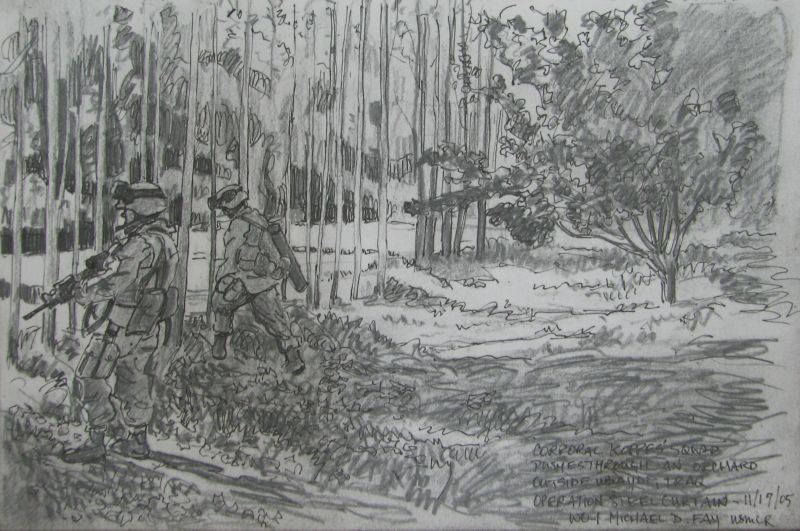
Marines, hardy individualists all, don't do anything solo when outside the wire. Every NCO or officer briefing a patrol or convoy peppers their instructions with two phrases, two non-negotiable operational concepts; battle buddies and guardian angels. The principle is simple, together we survive, alone we die. Whether filling sandbags, assigned the odious task of burning human waste, bearing a stretcher, patrolling or going out to snipe, you never go it alone, EVER. Today's photos and artwork are illustrative of this.

The two individuals whose photographs appear today, Michael Phillips of The Wall Street Journal and Hollywood documentary film maker Pat Dollard, were my battle buddies while at Ar Ramadi's Observation Post Horea. These two gentlemen, though fundamentally different creatively and politically, have fearlessly shared the common lot of the Marines here in Iraq. Mike was here on his fourth visit and Pat his third. Mike, a seasoned photo-journalist, works diligently to maintain the aloof impartiality of a judge even while enduring all the dangers and hardships faced by the Marines he covers. In addition to dispatches appearing regularly in The Wall Street Journal, he's also written a book entitled The Gift of Valor: A War Story. Lest one thinks his prose is limited to arid reporting, his reviewers assure us that this book displays the hand of a sensitive and evocative wordsmith. This intimate account of the life and heroic death of Medal of Honor nominee Corporal Jason Dunham leaves only the most hardened unmoved and dry eyed. Although he dons all the necessary protective combat gear, his fleece pullover and blue jeans leave no doubt that he's a non-combatant. On the back of his flack jacket is a large strip of duck tape with bold indelible ink letters spelling out PRESS. I asked him why he didn't have the same word in Arabic, and without blinking an eye responded, "it's there for the Marines, not the insurgents". The war in Iraq has been deadlier for members of the fourth estate than any other conflict. Pat Dollard, on the other hand, is a wild eyed zealot freshly descended from the mountain living on locusts and honey. He has found his long lost tribe, the Marines, and he's gone unapologetically native. A former Hollywood talent agent and producer, he's now living out a Hunter S. Thompsonesque complete immersion into the Heart of Darkness I now see the light who are these incredible human beings called Marines experience. Other than a usually unshaved mug, lack of rank insignia and weapon, he is indistinguishable from the jarheads he follows everywhere with camera shouldered and jaunty cigarette dangling from his lip. But don't let this description lead you to believe that Dollard is not the genuine article or that he's going off half-cocked with nary a plan. This is an articulate film maker on a mission. There is method in his madness and hopefully in the very near future the fruits of his labor will grace our television screens. Being with these two was enlightening, enriching and just plain fun.

The two individual portrait drawings show a duo best described as a pair of modern day Gunga Dins. Sergeant Becze and Lance Corporal Neier, assigned to Headquarters Company, 3rd Battalion, 1st Marine Regiment, together spent their days and nights during Operation River Gate in Haditha running food, water and ammunition to Marines out on the front lines. Time after time they left the relative safety of a firm base in an open back HUMVEE packed with essentials and navigated their way to isolated units through battle scarred alleyways. Often they returned with a load of enemy prisoners of war(EPWs)in their care. These guys, in danger coming and going, performed with a smile and the confidence that only comes from knowing that a buddy is always covering your six.

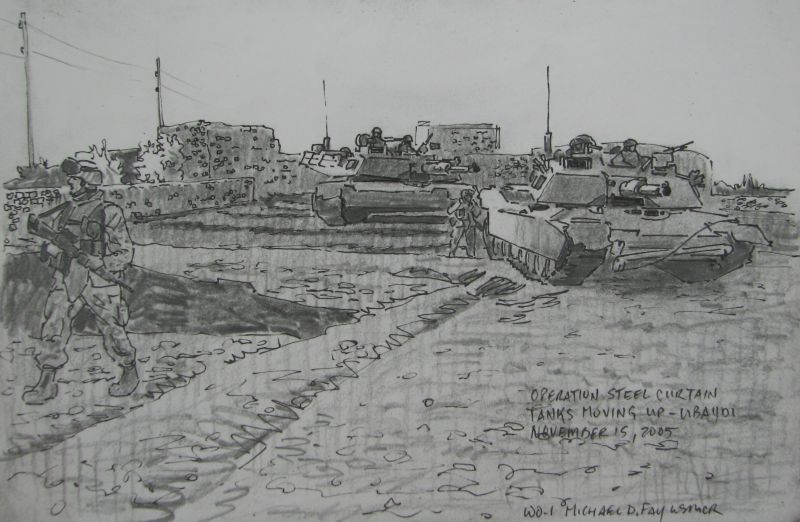
Finally, I give you a pair of inanimate objects; two M1A1 Abrams Main Battle Tanks as they move into position in support of Fox Company, 2nd Battalion, 1st Marine Regiment on the evening of November 15, 2005 in Old Ubaydi, Iraq. On the following day these behemoths would come dashing to the rescue of a pinned down unit, and become more than mere machines to the besieged 3rd Squad, 2nd Platoon of Fox Company. Each of these tanks has a team of four Marines on foot providing external security, and on the morning of November 16th one of these escorts, in desperate hand-to-hand fighting, probably earned a Navy Cross. Insurgents were throwing hand grenades from the roof of a hotly contested house, and Corporal A (I'll leave him anonymous until the award is approved and presented), down and seriously wounded in both legs, picked up a grenade and tried to toss it back inside. Unfortunately it detonated before he could get it completely inside amputating his right hand, but his selfless act of courage prevented anyone else from being killed or wounded.

Tuesday, January 31, 2006

Written in the Sky


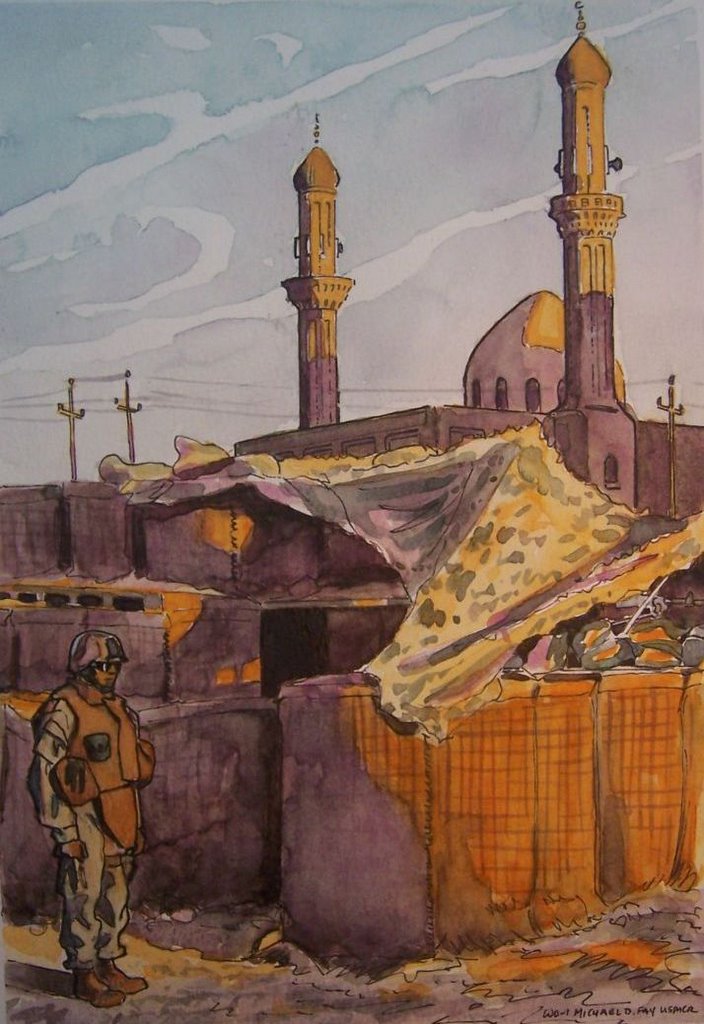
There are, among many, two very beautiful things here in Iraq. One is the warm glow that reaches across the flat terrain every evening. Sunlight stretching through the atmosphere with nary a hill betwixt you and it's source is magical. Objects glow with deep violet shadows and bright orange highlights. Many a Marine has come up to me wanting an email address so they can send me a beautiful sunset they've captured on a handy digital camera. The other thing of beauty, which takes a little while to develop a taste for, is Arabic calligraphy. Calligraphy means beautiful writing, and once the left brain surrenders trying to gleen literal meaning wandering up and down the rows of complex Koranic script, a harvest of visual inventiveness and vitality is there to satisfy the right brain's eye. I've tried to wed these two visual ideas, flaming sunset and Muslim calligraphy, in this watercolor. Although the sky here is almost always a great featureless expanse, there are times when high up delicate strokes of cirrus clouds leave their icy signatures. I'm not speaking of contrails from jets, but expressive stokes of satin white across the deepest blue of the sky. I can't help but wonder if these etheral shapes are the orginal inspirations for the Arabic alphabet. This scene shows a Marine standing post at the Entry Contol Point(ECP)for E/2/7 in downtown Fallujah. In the background stands a mosque freshly patched up following the previous years epic battle. This particular structure was the scene, both inside and out, of some of the bloodiest fighting.

Sunday, January 29, 2006

Breathe Deep the Gathering Gloom....


Some of you may surmise from the title of today's post that I'm a big Moody Blues fan. Nights in White Satin, they just don't write lyrics like that song anymore. "Cold hearted orb that rules the night, removes the colors from our sight, red is grey and yellow white...." Today I struggled with a nocturne. I have a very vivid memory of a trip out into Fallujah shortly after first arriving here. Under a blazing full moon we visited a gothic nightmare of a place called Observation Post Ethan. Getting into OP Ethan was like entering the decaying skeletal remains of a leviathan. The building's roof was flayed off of the rafters and hanging in fleshy tatters. To get to the main part of the OP you had to cross a courtyard thick with the dendrus of battle and, in the light of a full moon, combed by the exposed rafter's jagged shadows. I returned to OP Ethan during the day and took photos. Today I attempted to translate those day photos into a night scene. In preparation I googled "paintings, moonlight" and happened on a wonderful exhibition the National Gallery of Art put together a couple years ago devoted to Frederic Remington called "The Color of Night". Here's a quote that blew me away:

Layered, complex, and technically innovative, these images of night are also profoundly personal works of art. Filled with danger, threatened violence, and menacing silence, they mirror—metaphorically—Remington's experience of war.

Apparently Remington, after covering the Spanish American War in Cuba for Colliers Weekly, returned changed in significant ways both creatively and personally.

"Menacing silence" expresses perfectly what I was after. Nocturnes are very difficult to create. Remington was known for them as was Whistler and a Pennsylvania Impressionist named George Sotter. I haven't got it quite figured out yet, but it seems that your palette needs to be tuned heavily in the key of green, which, like sour apples, isn't always the most pleasing experience. But I gave it a shot and here's the result.

Saturday, January 28, 2006

Barbwire and HESCOs


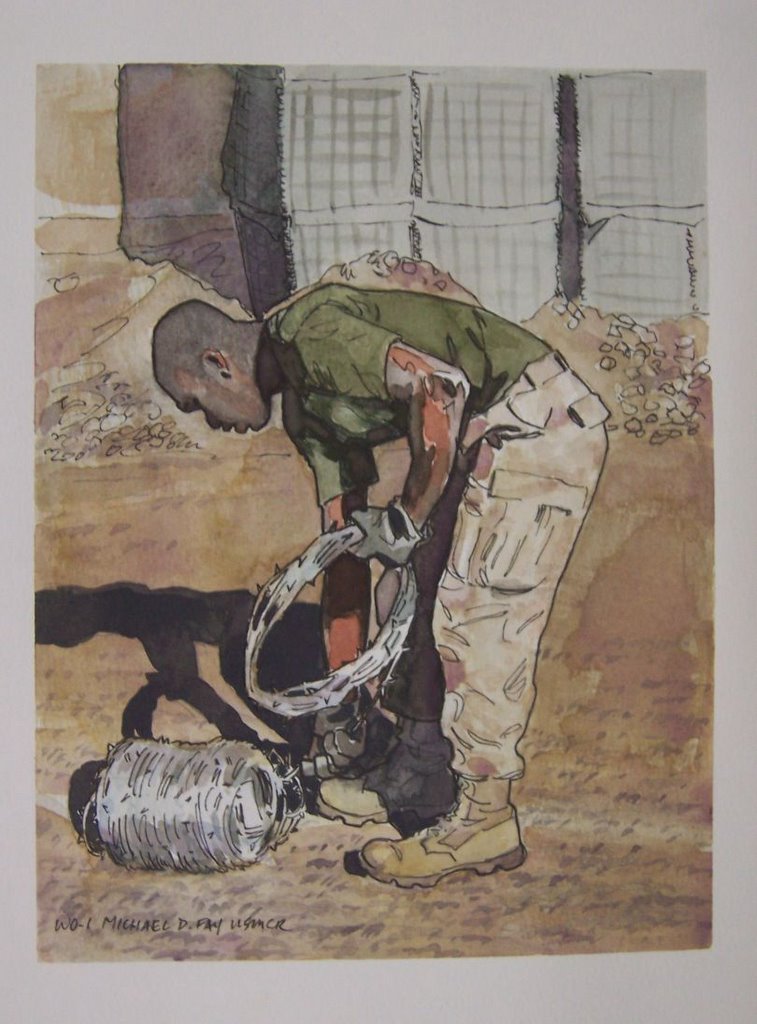
This is an image which is played out over and over both here and in Afghanistan; combat engineers putting out barbwire and setting up HESCO barriers. HESCOs are large light gray foursquare bags, fitted into wire mesh receptacles and then filled with dirt. Think of a paper grocery bag with its top edges folded over lining a trash can. Urban legend has it that each HESCO is incredibly expensive. Based on the rumors, which I won't repeat, anyone who invested in their namesake company prior to 9/11 is standing in high cotton. Inside the perimeter of these HESCO fortresses a thick blanket of gravel is laid down over the dirt. As a result inside the wire one develops a certain way of walking, much like the bowlegged gait used when strolling across soft deep sand at the beach. The crunch of boots trodding over golfball size rocks is the basic soundtrack of life here. The engineers wear thick leather gloves when unrolling and laying out barbwire. What you see here is a Marine creating a manageable skein of wire from a dense heavy mother spool. Somewhere in a cargo pocket out of sight is a heavy duty wire cutter. Having a good wire cutter readily available is a necessity for another reason. Barbwire is virtually invisible at night through NVGs(night vision goggles)and just about every Marine and soldier in Iraq can relate episodes where yards of it has wrapped itself around the axle and tires of an unsuspecting HUMVEE or 7 ton truck creating hideously confounding Gordian knots. Like Alexander the Great's response to Gordius' challenge there's only one solution(usually discovered after a futile attempt at backing up has geometrically compounded the problem)available to the Marines, cut, cut and cut some more.

Friday, January 27, 2006

Returning to the World....of Color


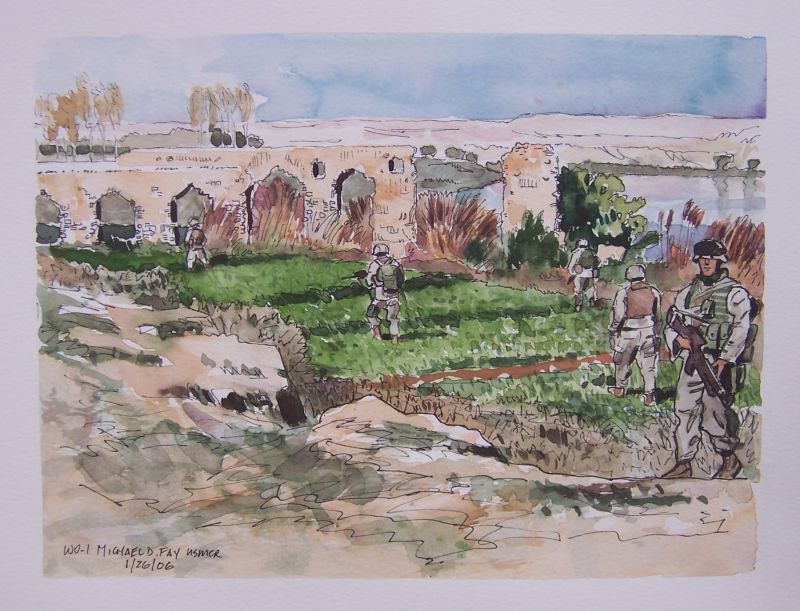
As you've probably noticed, other than the photographs, the overwhelming majority of new artwork posted here has been black and white graphite drawings. Over the next couple weeks I'll try to rectify that with a series of small watercolors. The piece with this posting shows a patrol of Marines from 3rd Platoon F/2/1 along the south bank of the Euphrates west of Ubaydi, Iraq. The north bank, which many Marines thought was Syria, was barren. Along their line of march stretched miles of fields broken by orchards and windbreaks of delicate poplars. Every kilometer or so there were ancient, but still functioning aquaducts. The pastoral stillness was broken only by the shugging heartbeat of equally decrepit pumps drawing water up from the river and channeling it down well packed earthen troughs out into the thirsty fields.

Today I attended the first of several briefs that are part of the standard issue "returning to the world" readjustment process. The Marines are very aware that the transition from Iraq back to the States, from combat to home and hearth, is one that needs to be handled with the same tactical devotion as a full frontal assault on a fortified position. Today's initial meeting was conducted by a chaplain and dealt primarily with family and post-traumatic stress issues. Like the food in the chow halls over here, the ideas and information were mostly very good and dished up in a tasteful and interesting way. The chaplain, like most I've gotten to know and observe, was adept at seasoning the material with necessary dashes of ribald humor, while at the same time balancing that with hearty warmth and deep-dish seriousness. He peppered his presentation with “can I have an Amen”s and “oorah”s. The thing which most caught my ear was the insistence that we "warriors", whether cook or trigger puller, share our stories with each other as often as possible. Prefaced with a brief synopsis of the tale of Ulysses, the palliative value of storytelling could not, according to the padre, be stressed enough. I realized there and then how blessed I am by my mission as a professional storyteller of sorts. People, including myself, often wonder how is it I can go into combat with the frequency I do and not be a raving nut case. ( I recognize that there are a couple exes, marital and otherwise, who might want to weigh in and have their say at this point.) Today I realized it's in large part because I get to tell my story, and knowing that you good folks are out there listening, to quote Robert Frost, has made all the difference. Thanks.

Wednesday, January 25, 2006

Of Quasimoto, Dogs, Death and God


Out on the battlefield communication is important on many levels. Company commanders follow closely behind their Marines as they press forward through a maze of walled courtyards and Byzantine streets. With a radio handset pressed into one ear and a strangle hold on a well worn map these seasoned professionals orchestrate a deadly game of cat and mouse. Geometry of fire is the watchword of the day as they regulate the movement of their platoons trying to stay on line with flanking sister units while maintaining aggressive contact to the front. Often the only things these captains have to go on are the tin can garble of radio traffic, the sound of gunfire, and rising plumes of smoke. They ultimately have to trust their own experience and intuition. Most will tell you what a challenge it is to restrain a company of Marines once their blood is up, the scent fresh and the chase is afoot. With their personal entourage of radiomen in tow they leapfrog forward through gaping holes sledge hammered and blasted into walls by the advancing squads. Identifying the Iraqi home with the highest roof, a temporary command post and overwatch is set up, and the advance to the next phase line intitiated. The radiomen set up their gear and collapse into shady corners. These hybrid grunts,loaded down with personal gear, weapons, ammo, radio and extra batteries, carry more than anyone on the battlefield. Often they have to sprint to the next position over walls and down exposed alleyways. A common sight is a RO (radio operator)bent over Quasimoto-like, leaning heavily on his rifle and leashed by a corkscrewing handset cord to an officer.

Another form of communication on the battlefield is more intimate and basic. It's the communication between the military working dog handlers and their canine charges. These Marines, with their explosives sniffing assistants, dart from one IED or weapons cache' site to another. Marine and dog are inseperable day and night. With subtle hand signals and firm commands the handler manages his dog. With kind words, pats on the head, close body contact and treats he keeps his buddy's morale up. Most dog handlers I've spoken with will quickly tell you how sensitive their dogs are to the stress of combat. They are very attuned to signs, like listlessness and weight loss, that suggest PTSD is starting to affect their partner.

Somewhere unseen in the battle space are the snipers. From their "hides" they send out final death notices sealed in 173 grains of 7.62mm lead. On the shoulders of these highly trained marksmen rests a weight of divine proportion. Unseen and with mythic skill they protect their fellow Marines from afar, and are the last person to see the unwary insurgent take his final earthly breath.

Communication to the Man Upstairs is also addressed out among the sound of gunfire and the acrid smell of cordite. Chaplains and religious program specialists roam the battlefield offering words of encouragement and listening ears. The portrait accompanying this post is of "padre" Lieutenant Bryan Crittendon USN. I traveled with him in the back of a amphibious assault vehicle out into the mean streets of Husayba, Iraq. His tired worldly eyes sparkled with a special infectious light; the personification of enthusiasm. Enthusiasm is an interesting and appropriate word in this case. It comes from the Greek, entheos, which means God within, and this chaplain, a former Marine helicopter pilot, was fully possessed of it.

Saturday, January 21, 2006

Ar Ramadi Images

Belt of Iraqi 7.62mm x 54R Machine Gun Ammo


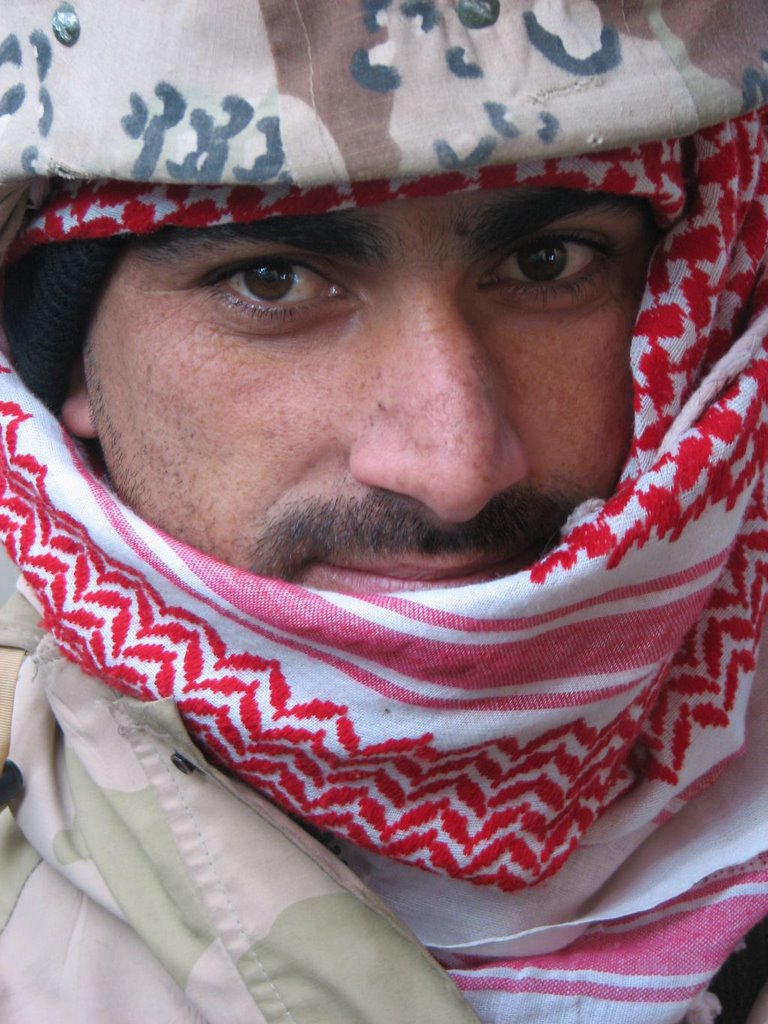
"Jundi"....an Iraqi Soldier


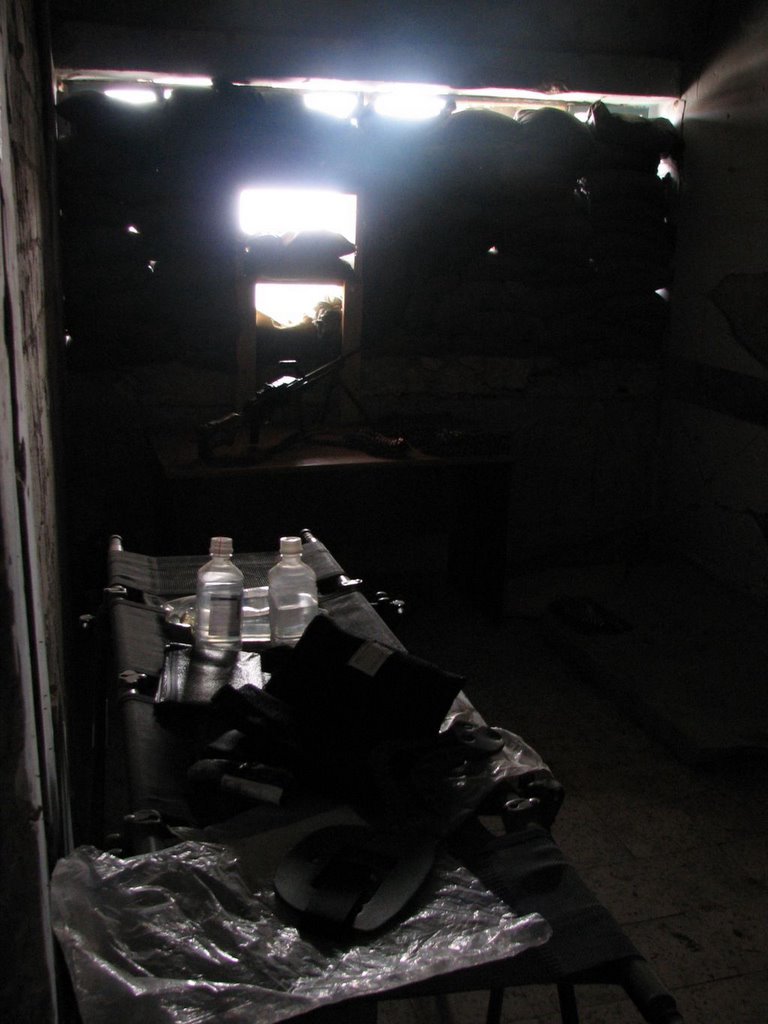
Aid Station and Battle Position


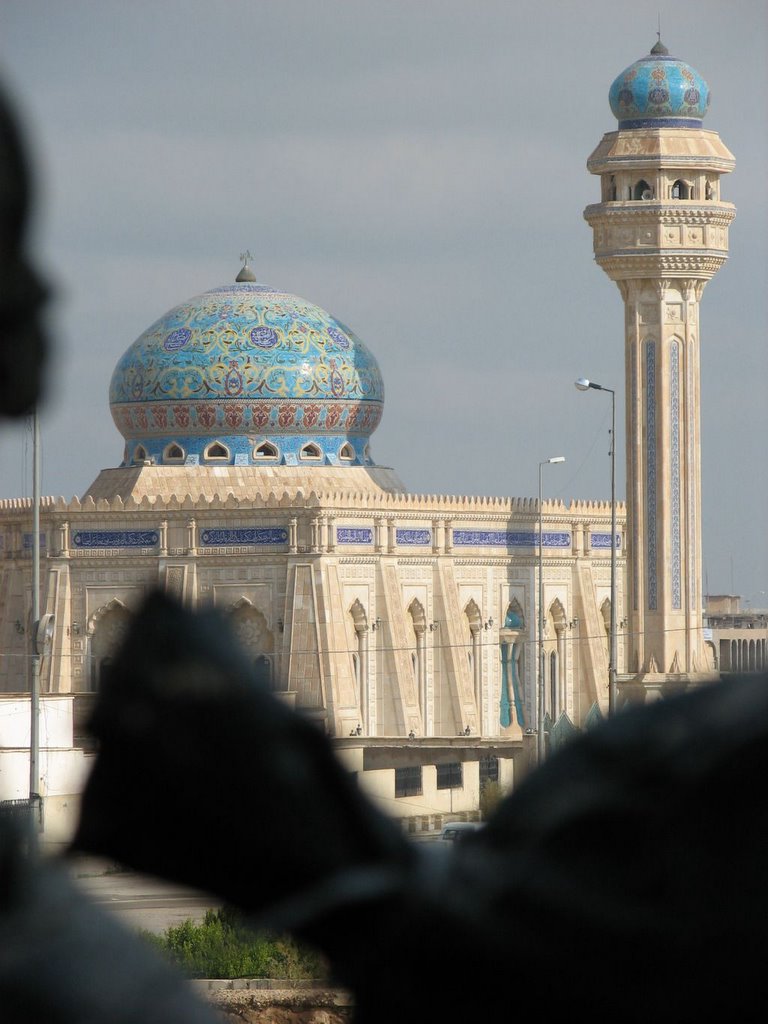
Saddam Mosque


Sergeant of the Guard Making the Rounds


Looking Down MSR Michigan Towards Government Center


The city of Ar Ramadi was a target rich environment visually alive with people, objects and surfaces. Here are several photographs of things mentioned in the previous entry along with a few others to give some sense of the atmosphere that pervades a place such as OP Horea. Here is the face of an Iraqi jundi, brave and generous. The Marines, weary of MREs, look forward to their invitations to share home cooked meals on the first deck. A sergeant of the guard disolves in the dappled light under the mantle of camouflage netting. A belt of machine gun ammunition at the ready coiled and deadly. A view of Saddam Mosque as seen from a fighting position, and a devestated stretch of MSR Michigan lying between Government Center and OP Horea at twilight. In future postings you'll be presented with essays in the form of images to hopefully deepen an appreciation of the texture of life in this troubled city.